
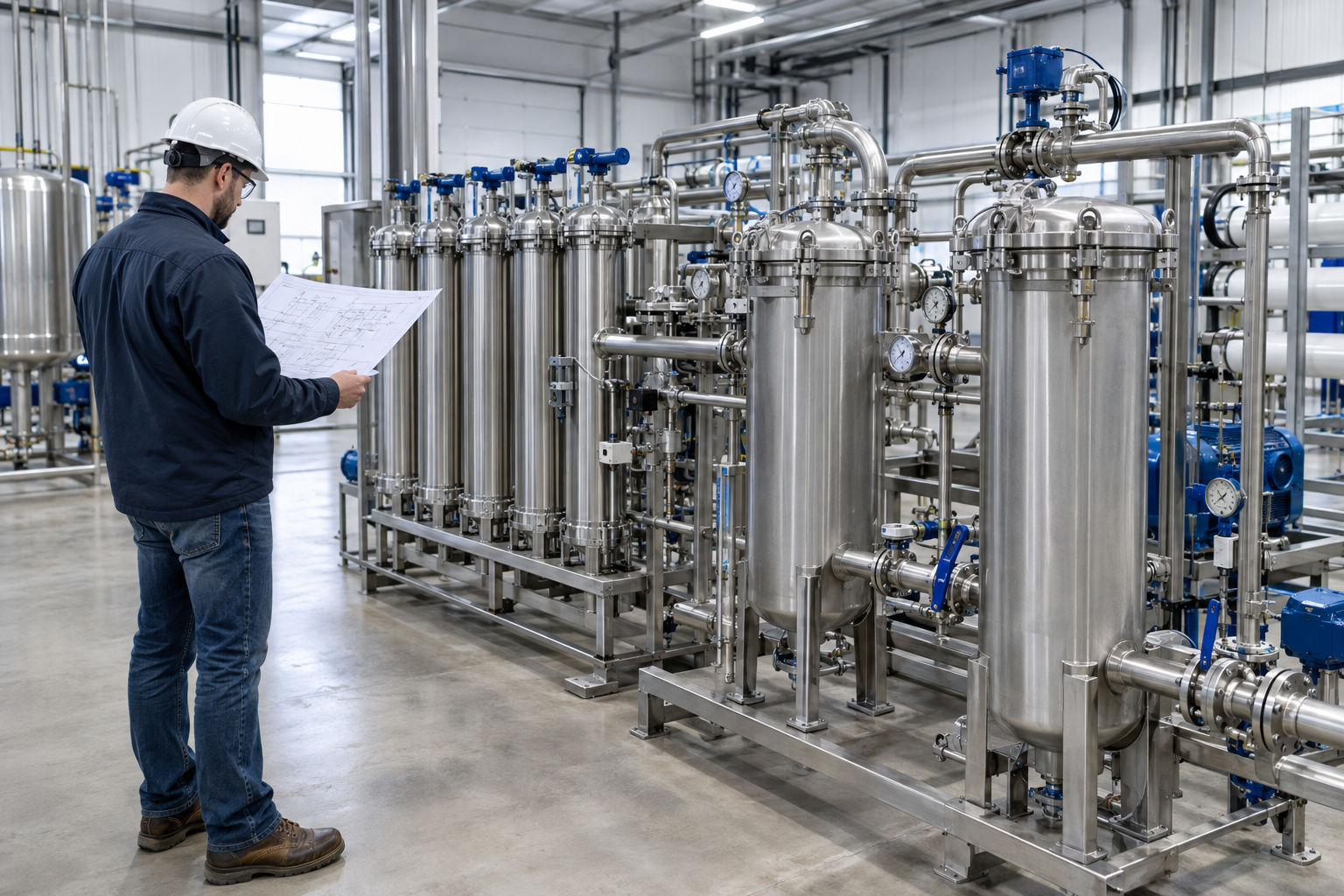
How to choose an industrial filtration equipment supplier (USA)
How to choose an industrial filtration equipment supplier (USA)
The best industrial filtration equipment supplier is not necessarily the one with the largest catalogue. Choose the supplier that can match the filtration duty to your fluid, contaminant, operating conditions, materials requirements and required treated quality—and then support that recommendation with clear documentation, service arrangements and maintainable equipment.
This approach is especially important for US facilities in oil and gas, marine, semiconductor, power, food and beverage, chemical, pharmaceutical, pulp and paper, and industrial water treatment. Before requesting quotations, prepare a consistent process brief and ask every shortlisted supplier to respond to the same technical and lifecycle questions.
How to frame the supplier decision
You are comparing more than a filter housing or replacement element. The decision includes application engineering, equipment fit, materials compatibility, performance evidence, documentation, installation support, spare parts and after-sales service. A large selection can make choosing difficult, so ask application experts to explain why a proposed configuration fits your process rather than accepting a product list as a recommendation.
Also verify the supplier’s ability to support your project in the United States. Confirm communication channels, delivery arrangements, technical contacts, service coverage and the documents provided with the equipment. Do not treat an export history, catalogue breadth or general industry statement as proof that a particular supplier can meet your site’s requirements.
For an initial view of available equipment categories, review the filtration product gallery. Use it to identify possible equipment families, not to replace process evaluation.
Build an application and process brief
Suppliers cannot compare technologies reliably if the duty is described only as “water filtration” or “particle removal.” Send the same information to each bidder:
- Fluid: identify the process liquid, source, chemistry and whether its composition changes during operation.
- Contaminant: describe the particle or other substance to be removed, including available particle-size distribution and solids-loading data.
- Operating conditions: provide normal and maximum flow rate, inlet and outlet pressure, temperature, pressure variation and allowable pressure loss.
- Materials: state compatibility constraints, including relevant chemicals, pH, chlorides, solvents or cleaning agents where known.
- Required result: define the treated-water or process-quality target and what happens if contaminant breakthrough occurs.
- Operations: explain expected run time, cleaning or changeout preferences, access limits, automation needs and available maintenance staff.
Include variability, not just design-point values. Fouling, changing solids concentration and pressure spikes can change the correct housing, media, control strategy and maintenance plan. Ask suppliers how their proposal responds to those events and what measurements should trigger inspection, cleaning or element replacement.
Treat a pressure spike as a troubleshooting and selection question, not as a reason to change equipment categories immediately. Ask the supplier to explain how the proposed system should respond when pressure rises, which measurements distinguish normal loading from a process upset, and what inspection or shutdown action is expected. The review may involve a strainer, bag or cartridge housing, multimedia or cloth-media filter, membrane stage, or self-cleaning system; the appropriate choice still depends on the contaminant, flow, pressure, temperature, materials and required quality. If continuous service and changing solids loading are central concerns, you can ask whether a self-cleaning filtration system warrants comparison, provided the supplier supports that comparison with process-specific assumptions and validation criteria.
If the feed is uncertain, obtain representative testing before final selection. Public drinking-water guidance distinguishes treatment categories and emphasizes matching treatment to the contaminants present; the same decision principle is useful when defining an industrial water-treatment duty. The CDC explains that different treatment systems remove different contaminants and that water should be tested before equipment is selected.
Test the technical fit of the proposed solution
There is no universally best filtration method. Depending on the duty, a proposal may include strainers, clarification, multimedia or cloth-media filtration, bag or cartridge housings, membrane processes, adsorption, ion exchange or ultraviolet disinfection. EPA treatment guidance describes these as distinct stages whose performance depends on proper design, optimization and operation. Review the EPA treatment-stage guidance when comparing the role of pretreatment, filtration, membranes and disinfection.
Compare the removal objective with the operating burden
Evaluate each proposed stage against five questions:
- What contaminant or process risk is this stage intended to address?
- What performance basis supports the recommendation?
- How will flow, pressure loss, energy demand, recovery and waste affect operation?
- What maintenance, cleaning, consumables or downtime will it require?
- Is it compatible with the feed, downstream equipment and required quality target?
Reverse osmosis may address many dissolved salts and certain chemicals, while membrane performance depends on the membrane type, pore-size distribution, influent quality and contaminant. Microfiltration, ultrafiltration, nanofiltration, reverse osmosis and ultraviolet treatment therefore should not be treated as interchangeable solutions. The proposed method must be tied to a defined contaminant and verified performance target.
A multi-barrier system may be appropriate when each stage has a defined job. More stages do not automatically mean better performance. Each additional housing, membrane, pump or disinfection stage can add pressure loss, controls, maintenance and failure points. Ask the supplier to explain the complete flow path and the consequence of bypassing or shutting down each stage.
For high-solids or continuous service, ask whether a self-cleaning arrangement is justified by the solids loading, cleaning cycle and acceptable downtime. For batch, lower-flow or sanitary service, a bag or cartridge housing may offer a simpler operating arrangement. These are starting points, not universal rules; the supplier should confirm the fit using your process data.
Use a supplier comparison table
Score each proposal using the same evidence request. Avoid awarding points for an attractive presentation when a material assumption or performance basis is missing.
| Evaluation area | What to compare | Evidence to request |
|---|---|---|
| Application expertise | Experience with the same fluid, contaminant duty and operating pattern | Relevant references, duty descriptions or application explanations |
| Proposed technology | Why bag, cartridge, media, membrane, UV or self-cleaning equipment is used | Process flow, selection rationale and stated assumptions |
| Performance basis | Removal objective, capacity and pressure-loss expectations | Calculations, curves, test data or a defined validation method |
| Materials compatibility | Wetted materials against fluid, temperature and cleaning chemistry | Material descriptions, compatibility information and applicable certificates |
| Maintenance | Changeout, cleaning, inspection, spare parts and access requirements | Maintenance instructions, consumable specifications and replacement plan |
| Documentation and service | Installation, commissioning, training, repair and after-sales support | Manuals, drawings, service contacts and warranty terms |
| Risk response | Handling of fouling, loading changes, pressure excursions and performance problems | Alarm or inspection logic, troubleshooting process and escalation path |
Ask each supplier to identify which statements are measured results, design calculations, assumptions or general guidance. This distinction helps separate verifiable evidence from sales claims. Service capability should also be specific: look for documented installation, service and repair experience, named responsibilities and a clear route for technical help. A claimed certification or long service history should be verified rather than treated as proof of suitability.
When a supplier highlights decades of service or certified filtration technicians, turn that statement into a verification request rather than treating it as proof of suitability. Ask what the certification covers, which personnel would support your project, and whether their experience includes installation, troubleshooting and repair of comparable industrial equipment. Request defined responsibilities, escalation contacts and examples of the service documents supplied with the system. A long operating history may indicate established support, but it does not confirm compatibility with your fluid, pressure range or quality target. The useful comparison is the supplier’s documented ability to support this duty throughout commissioning, operation and repair—not the age of the company claim alone.
Make the shortlist decision
Proceed to commercial review when a supplier has matched the stated duty, explained the performance basis, addressed materials compatibility and documented maintenance and service support. Request clarification when the proposal omits flow variability, pressure-loss assumptions, consumable life, test conditions or the response to performance problems.
Escalate to a qualified process engineer or specialist review when the feed is highly variable, pressure changes are severe, materials compatibility is uncertain, product quality is critical, recovery targets are demanding or several treatment stages must work together. Catalogue comparison alone cannot resolve those conditions safely.
When validation is worth the effort
For uncertain applications, consider a sample-based pilot, field validation or a factory acceptance test when it is proportionate to the project risk. Define the test objective, feed condition, measurements, acceptance method and responsibility before agreeing to it. A test should answer a decision question—for example, whether the proposed stage reaches the required quality at the stated flow and pressure—not simply create more documentation.
Before installation, confirm that the supplier’s approved instructions, technical drawings and site safety procedures take precedence over generic guidance. The installation sequence, limits and inspection requirements must be checked against the specific housing, cartridge, bag or treatment system.
For a deeper explanation of this equipment-specific distinction, see the high-flow cartridge filter housing installation guide.
FAQ: questions to ask an industrial filtration supplier
Frequently Asked Questions
What equipment types are used for industrial liquid filtration?
Common equipment includes strainers, bag filter housings, cartridge filter housings, multimedia or sand filters, cloth-media filters, membrane systems and self-cleaning filtration systems. A complete plant may also use clarification, adsorption, ion exchange or disinfection. Reverse osmosis can address many dissolved salts and certain chemicals, while membrane and ultraviolet performance depends on the specific technology and treatment objective. The right combination depends on the contaminant, flow, pressure, temperature, materials and required quality rather than on equipment category alone.
When should I choose a self-cleaning system instead of bag or cartridge filters?
Choose a self-cleaning system only when its cleaning method, solids-handling behavior and control requirements fit the duty and justify the added system complexity. Bag or cartridge equipment may be more practical where flow is intermittent, maintenance access is acceptable or straightforward element replacement is preferred. Ask for expected cleaning frequency, solids assumptions, pressure loss and manual intervention requirements.
Which documents should I request before approving a supplier?
Request an application-specific proposal, process flow, drawings, operating assumptions, wetted-material information, pressure and temperature limits, performance calculations or test data, maintenance instructions, recommended consumables, spare-parts information, installation guidance and service contacts. Also ask which values remain to be confirmed before manufacture.
Do I need to test my water or process fluid before choosing equipment?
Yes, where the feed composition or contaminant duty is uncertain. Test results can help define particulate loading, chemistry, temperature and the required treatment objective. The CDC advises matching treatment to the specific germs or chemicals present, and a representative sample or pilot can help resolve uncertainty before final equipment selection.
What should I do if two suppliers recommend different technologies?
Ask both suppliers to address the same contaminant, quality target, pressure-loss limit, maintenance expectation and operating range. Then compare their assumptions and evidence rather than comparing technology names. If the difference remains material, use representative fluid testing or a defined pilot to resolve the uncertainty.
Request an application-specific proposal
Prepare your process brief before contacting an industrial filtration equipment supplier. Include the fluid, contaminant data, flow range, pressure and temperature, materials constraints, quality target, maintenance expectations, site requirements and requested documentation. Then ask for a proposal that explains the equipment choice, assumptions, validation method and long-term support. Contact Suzhou Ruickly Purification Technology Co., Ltd. to discuss your filtration project and provide the information needed for a focused technical response.