
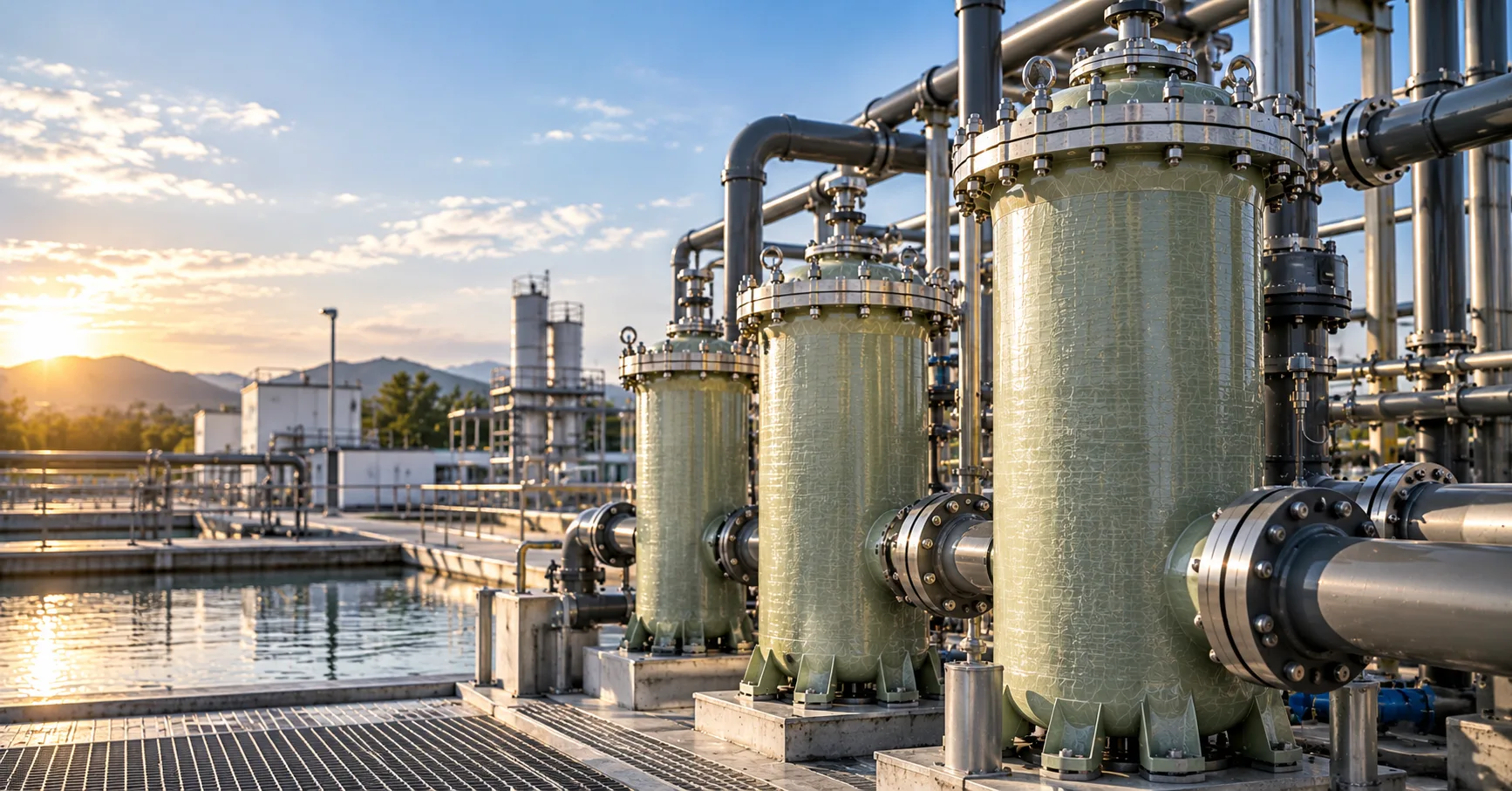
FRP Filter Housing: Advantages, Limitations & Industrial Applications
FRP filter housings offer several advantages for industrial liquid filtration, particularly where corrosion resistance, equipment weight, and material compatibility influence equipment selection. However, their suitability depends on the composite construction, process chemicals, operating pressure, temperature, and filtration requirements.
This guide explains the advantages and limitations of FRP filter housings, where they are commonly considered, and what engineers and industrial buyers should verify before selecting equipment or requesting a quotation.
What Is an FRP Filter Housing?
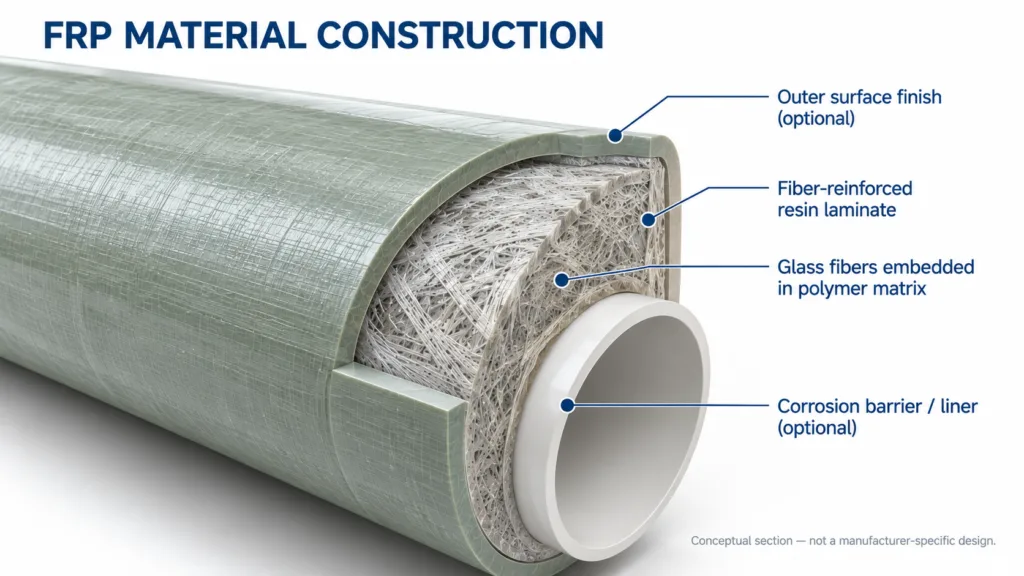
FRP stands for Fiber-Reinforced Plastic, a broad category of composite materials combining reinforcing fibers with a polymer matrix. In industrial filtration, FRP housings contain process liquids and support filter bags or cartridges while directing flow through the filtration elements.
The housing provides containment and mechanical support; particle removal is performed by the installed filter media. Consequently, an FRP housing does not inherently deliver a particular micron rating or filtration efficiency.
Not all FRP constructions are equivalent. Conventional fiber-reinforced thermoset composites use cured resin systems and reinforcing fibers, sometimes with a separate corrosion barrier. Glass-fiber-reinforced thermoplastics, such as reinforced polypropylene, use a different polymer matrix and may have different chemical, thermal, and mechanical characteristics.
These differences matter when comparing published product specifications.
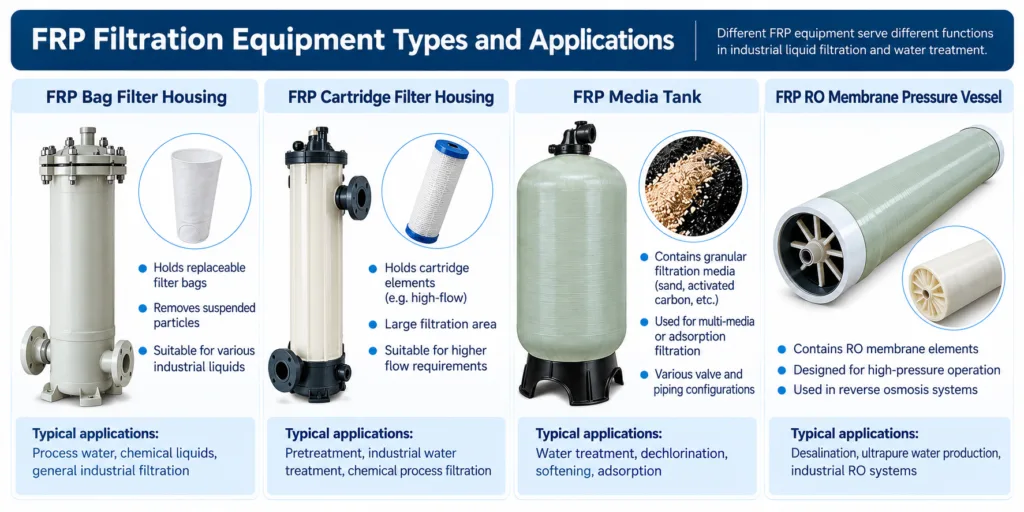
FRP equipment also includes several distinct product categories:
- FRP bag filter housings contain replaceable filter bags.
- FRP cartridge filter housings accommodate cartridge elements, including high-flow configurations.
- FRP media tanks contain granular filtration media such as sand or activated carbon.
- FRP RO membrane pressure vessels contain reverse-osmosis membrane elements.
Key Advantages of FRP Filter Housings
1. Corrosion Resistance in Suitable Chemical Environments
One of the principal FRP filter housing advantages is the potential for corrosion resistance in applications where certain metallic materials may deteriorate.
Unlike carbon steel, an appropriately selected FRP material system does not rely on a metallic surface to resist rust. Depending on the resin or polymer matrix and the wetted construction, it may also tolerate selected corrosive liquids that would require a more corrosion-resistant metal alloy.
This can make FRP worth considering for certain industrial water-treatment, saline, and chemical-processing applications.
The advantage is conditional, however. Resin chemistry, chemical concentration, temperature, and exposure duration determine whether the material is appropriate. In addition, connections, end caps, and elastomer seals may have different chemical limitations from the main housing body.
For buyers, the relevant question is not whether FRP is generally corrosion-resistant, but whether the proposed complete wetted assembly is compatible with the process environment.
2. Lower Weight and Easier Equipment Handling
FRP housings may weigh less than appropriately comparable metallic designs, depending on vessel dimensions, reinforcement, wall construction, and fittings.
A lower empty weight can simplify transportation, lifting, and positioning during installation. This may be particularly useful when retrofitting equipment into an existing plant or working within restricted lifting access.
Nevertheless, equipment weight should be evaluated alongside installation requirements.
The filled operating weight includes the housing, liquid, and installed filtration components. Mounting supports must accommodate this load together with relevant piping forces and maintenance activities.
A lighter vessel may also require substantial overhead clearance for cartridge or bag removal. Therefore, procurement comparisons should consider empty housing weight, filled operating weight, installation dimensions, maintenance clearance, and mounting or piping loads rather than empty weight alone.
3. Application-Specific Material and Housing Configurations
FRP housings are available in different filtration arrangements and material constructions.
For instance, a single-bag housing and a high-flow cartridge housing may both use reinforced polymer materials but serve different element configurations and hydraulic requirements.
This range allows buyers to evaluate equipment according to filtration type, connection arrangement, available space, and operating conditions.
However, available configurations depend on the manufacturer’s actual product designs. Changes to vessel dimensions, connections, or pressure-containing components may require additional engineering review.
The practical benefit is a wider selection of potentially suitable designs—not unlimited customization.
4. Potential Lifecycle and Maintenance Benefits
Where corrosion is a significant source of equipment deterioration, a compatible FRP housing may reduce some corrosion-related maintenance concerns.
Similarly, lower equipment weight can offer handling advantages during installation or replacement.
These benefits may influence total ownership cost, especially when metallic alternatives would require more expensive corrosion-resistant alloys or protective measures.
Even so, FRP does not guarantee lower lifecycle cost.
Initial purchase price, filter element consumption, downtime, inspection requirements, repair restrictions, and replacement costs should be evaluated together. The most economical option is the one that satisfies the operating requirements at an acceptable total cost, not necessarily the lightest or least expensive housing.
Limitations and Disadvantages of FRP Filter Housings
FRP is not inherently superior to every metallic housing. Its limitations become important when process conditions approach the boundaries of the selected material system.
Chemical Exposure Can Affect Composite Performance
An FRP housing may resist one chemical while being unsuitable for another.
Certain chemicals can cause swelling, softening, degradation, or changes in the mechanical properties of polymer materials. These effects may occur without the visible rust associated with metallic corrosion.
Compatibility can also change with concentration and exposure duration.
For this reason, an unspecified FRP construction is not enough to establish suitability for aggressive chemical service.
Temperature Can Restrict Operating Conditions
Composite materials may lose mechanical performance as temperature increases. Chemical resistance can also deteriorate at elevated temperatures.
The allowable temperature therefore depends on the actual material construction and equipment design, not a universal FRP temperature limit.
A housing suitable for a process at ambient temperature may not be appropriate for the same liquid at a higher temperature.
Pressure and Structural Requirements Are Model-Specific
FRP pressure-containing components must be designed for the relevant internal pressure, geometry, connections, and mechanical loads.
Different constructions can have substantially different pressure capabilities.
In addition, pressure-temperature relationships may restrict the permissible operating conditions. A published pressure rating should not be assumed to apply unchanged across every temperature.
Mechanical Impact and Outdoor Exposure Require Attention
Impact, excessive piping loads, or improper handling can damage composite components.
Depending on construction, deterioration may involve cracking, exposed reinforcement, or internal damage that is not fully visible from the surface.
Outdoor installations introduce additional considerations, including ultraviolet exposure, weathering, and temperature variation. Suitability depends on the specific material and protective construction.
Inspection and Repair Can Be More Restrictive
Composite pressure-containing equipment may require inspection and repair procedures different from those used for stainless steel.
Surface damage does not always reveal the full extent of structural deterioration. Furthermore, some repairs may require manufacturer-approved methods, while other damage may justify replacement.
Where the project demands operating conditions, inspection methods, or repair practices that the proposed FRP design cannot support, stainless steel or another housing material may be more appropriate.
Chemical Compatibility — What Buyers Must Actually Verify
Chemical compatibility should be assessed as a complete operating-condition review rather than a simple material-name comparison. For general material-screening context, consult RTP Company chemical resistance guidance; this does not replace model-specific approval.
1. Identify All Process and Cleaning Fluids
List the normal process liquid, flushing solutions, cleaning agents, and any chemicals encountered during startup or maintenance.
A housing compatible with the main process liquid may still be unsuitable for a concentrated cleaning solution used periodically.
2. Establish Chemical Concentrations and Contaminants
Record relevant concentrations, pH where applicable, dissolved salts, and significant process additives.
Mixed chemical streams deserve particular attention because compatibility cannot always be determined from the primary chemical alone.
3. Define the Operating Temperature Range
Identify normal, minimum, and maximum temperatures, including cleaning and foreseeable upset conditions.
Chemical compatibility information obtained at room temperature may not represent performance at elevated temperature.
4. Identify the Actual Composite Construction
Determine whether the proposed housing uses a reinforced thermoset laminate, a reinforced thermoplastic, or another documented construction.
Where applicable, identify the resin system, liner, and corrosion barrier.
These details matter because two housings described as FRP may have different chemical resistance and mechanical properties.
5. Check Every Wetted Component
Review the housing body, connections, end caps, internal supports, O-rings, and gaskets.
For example, a compatible composite shell does not establish the chemical suitability of an ABS end cap, nylon connection, or elastomer seal.
The weakest incompatible wetted component may determine whether the complete assembly is acceptable.
6. Confirm the Proposed Configuration Against Actual Conditions
Submit the fluid composition, concentrations, temperature range, and operating conditions for evaluation.
Request identification of the relevant wetted materials and any available chemical compatibility documentation.
Where chemical exposure is especially demanding, additional material assessment may be necessary.
The resulting decision should apply to the complete proposed configuration rather than to FRP as a general material category.
Pressure, Temperature and Operating Conditions
Pressure terminology is important because different values describe different aspects of equipment suitability.
Normal Operating Pressure is the pressure typically encountered during routine operation.
Design Pressure is the specified pressure used as a basis for the equipment’s mechanical design.
Maximum Allowable Operating Pressure, where explicitly documented, identifies an applicable operating limit for the specified equipment and conditions. It should not be assumed to equal the design pressure. Some engineering codes instead use the defined term *Maximum Allowable Working Pressure (MAWP)*, which must be interpreted according to the applicable code.
Differential Pressure Across the Filtration Assembly is the pressure difference measured between the filtration inlet and outlet.
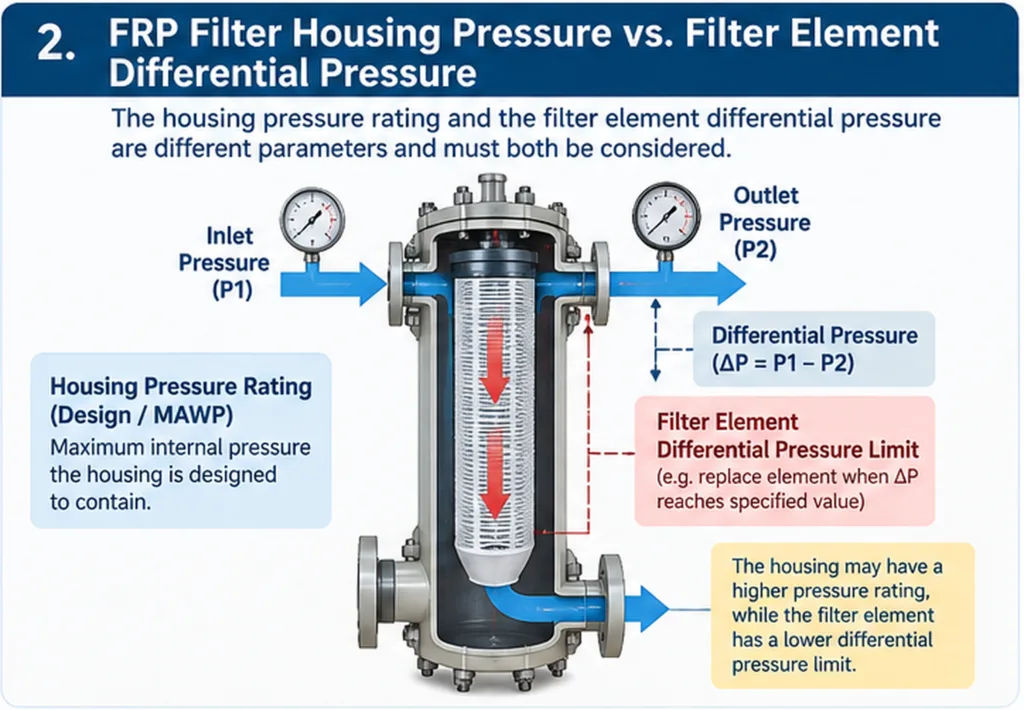
Maximum Allowable Differential Pressure of the Filter Element is the pressure difference the installed bag or cartridge is permitted to withstand under its specified conditions.
These values are not interchangeable.
For example, a housing may be designed to contain substantial internal pressure while the installed cartridge has a much lower allowable differential-pressure limit. Using the housing’s pressure rating as the cartridge replacement threshold could damage the element.
How to Evaluate Pressure and Temperature
Begin with normal operating pressure and the maximum pressure the equipment may encounter, including relevant transients.
Next, establish the complete operating temperature range. Confirm that the proposed housing’s allowable conditions remain suitable at the required temperatures rather than comparing pressure and temperature ratings independently.
Then evaluate the filtration element.
The expected clean-element pressure drop at the design flow provides a baseline for hydraulic performance. As solids accumulate, pressure drop generally increases.
If the initial pressure drop is already close to the permitted operating differential pressure, the configuration may offer insufficient loading margin even though the housing itself can contain the system pressure.
In that case, additional filtration area, a different element configuration, or a revised operating arrangement may be necessary.
Fluid viscosity also matters: a more viscous liquid can increase pressure drop at the same volumetric flow.
Finally, vacuum or negative-pressure conditions require separate assessment. A positive internal-pressure rating does not automatically establish resistance to external-pressure loading.
For projects requiring compliance with a particular pressure-equipment standard, the relevant code and its scope must be identified. For example, ASME RTP-1 addresses a defined category of reinforced thermoset plastic corrosion-resistant equipment; it is not a universal certification for all FRP pressure vessels.
No particular Ruickly product should be assumed to comply with that standard without model-specific supporting documentation.
FRP vs Stainless Steel Filter Housing
Both FRP and stainless steel can be appropriate for industrial filtration. The better choice depends on the actual process requirements.
I am raw html block.
Click edit button to change this html
For instance, a compatible FRP housing may be attractive where corrosion of a particular metallic grade would be a significant concern.
Conversely, a stainless steel housing may be preferable when operating temperature, mechanical loads, or project requirements exceed the capabilities of the proposed FRP configuration.
The comparison should use actual model specifications rather than general material assumptions.
For a broader discussion of filtration equipment types, see Ruickly’s comparison of bag, cartridge, stainless steel, and FRP filter housings.
Common Industrial Applications
Industrial Water Treatment
In an industrial water-treatment system, an FRP bag or cartridge housing may be installed after a pump or upstream treatment stage to remove suspended particles before the water enters downstream equipment.
The filtration element performs the particle removal, while the housing contains the liquid and supports the element.
FRP may be considered where corrosion exposure or equipment weight makes a compatible composite construction attractive.
However, water chemistry, treatment additives, operating pressure, and temperature must be checked against the proposed housing’s materials and ratings.
Pretreatment Before Downstream Filtration Equipment
Cartridge filtration may be used as a pretreatment stage upstream of equipment requiring controlled particulate loading, including certain membrane-treatment systems.
Here, the cartridge housing holds the elements that reduce suspended particles before the liquid reaches the next process stage.
FRP construction may be useful when the surrounding chemical environment favors a suitable nonmetallic housing.
Nevertheless, cartridge selection must follow the downstream equipment’s filtration requirements. A high-flow cartridge housing is not an RO membrane pressure vessel, and its suitability cannot be inferred from the design of the membrane vessel installed farther downstream.
Selected Chemical-Process Liquids
A bag or cartridge housing may be installed within a chemical-processing transfer or recirculation line to remove suspended contaminants from a process liquid.
FRP may be considered when the chemical environment presents corrosion concerns for certain metallic alternatives.
In this setting, the most important selection question is whether the entire wetted assembly tolerates the specific chemical mixture at the required concentration and temperature.
Cleaning agents and process changes should also be included in the assessment.
Saline and Chloride-Containing Environments
Industrial systems handling saline water or chloride-containing liquids may use filtration housings to remove suspended solids before downstream treatment or process equipment.
Suitable FRP construction may offer an alternative where corrosion of metallic equipment is a concern.
Even so, the presence of salts does not automatically establish compatibility. The selected polymer system, connections, seals, operating temperature, and pressure conditions must be appropriate for the application.
General Industrial Process-Liquid Filtration
FRP bag and cartridge housings may also be considered in general process-liquid filtration systems where suspended particles must be removed during production, transfer, or recirculation.
The choice between bag and cartridge filtration depends on particle-retention requirements, flow, solids loading, and maintenance expectations.
FRP material selection is a separate decision based on chemical and mechanical suitability.
What to Check Before Purchasing an FRP Filter Housing
A technical quotation should provide enough information to evaluate both filtration performance and the housing’s operating limits.
I am raw html block.
Click edit button to change this html
A housing may satisfy the required flow while still producing excessive pressure drop with the intended liquid and filter element.
Likewise, an appropriate housing material does not compensate for a filter element that lacks the required retention efficiency or acceptable service life.
These considerations should be evaluated together before approving a configuration.
Technical Documents Worth Requesting
For engineering and procurement review, useful documents may include:
- General arrangement and dimensional drawings.
- Material and wetted-component information.
- Model-specific design and operating limits.
- Filter element dimensions and compatibility information.
- Available inspection or testing documentation.
- Installation and maintenance instructions.
- Applicable certification or compliance documents, where available and required.
Not every product necessarily has the same documentation or certifications. Buyers should identify their project requirements and establish which supporting records can be provided for the exact proposed model.
Ruickly FRP Filter Housing Configurations
Ruickly publishes several FRP housing configurations for different filtration arrangements.
The following examples illustrate why model-specific specifications matter when comparing equipment.
FRP Single Bag Filter Housing
Ruickly’s FRP Single Bag Filter Housing uses a bag-based filtration arrangement.
Its published product specifications identify:
- Material: Glass-fiber-reinforced polypropylene.
- Inlet/outlet: 2-inch ANSI flange.
- Bag size: 150 mm diameter × 560 mm length.
- Maximum flow rate: 20 m³/hr.
- Maximum pressure: 7 barg.
- Maximum temperature: 40°C.
- O-ring material: Viton.
The material description is important because reinforced polypropylene is a thermoplastic-based construction and should not automatically be treated as equivalent to a conventional reinforced thermoset laminate.
The listed bag dimensions also establish a specific element-fit requirement.
Although the product page provides maximum flow, pressure, and temperature figures, buyers should confirm the applicable operating assumptions and the filtration performance of the proposed bag.
In particular, the published maximum flow figure does not establish the clean-bag pressure drop or expected replacement interval for every process liquid.
FRP High Flow Cartridge Filter Housing
Ruickly’s FRP High Flow Cartridge Filter Housing is designed around high-flow cartridge elements.
The published specifications include:
- Shell: FRP.
- Side port: Nylon.
- End caps: ABS.
- Housing lengths: 40-inch and 60-inch options.
- Inlet/outlet: 3-inch coupling-type connection.
- Design pressure options: 7 bar and 16 bar.
- Connection arrangements: Side port and end port.
This configuration illustrates the importance of assessing multiple wetted materials.
The FRP shell, nylon side port, and ABS end caps may have different chemical compatibility limits.
Furthermore, the 7-bar and 16-bar design pressure options must be associated with the correct product configuration. Neither figure should be interpreted as a universal pressure rating for all Ruickly FRP housings.
The selected cartridge must also meet the required flow, retention performance, and allowable differential-pressure conditions.
FRP Cartridge Filter Housing CFLG-5 to 20 SB
Ruickly’s FRP Cartridge Filter Housing CFLG-5 to 20 SB lists:
- Material: GRP.
- Finish: Smooth.
- Inlet/outlet: 1.5-inch socket.
- Vent: 1/4-inch NPT female.
- Drain: DN15 socket.
These details help buyers evaluate piping connections, venting, and drainage arrangements.
However, the reviewed product page does not provide a complete set of pressure, temperature, filter element, and chemical compatibility information for final engineering selection.
Those specifications should be confirmed for the proposed configuration before purchase.
Choosing Between Ruickly's FRP Configurations
The first decision is whether the application requires bag filtration or cartridge filtration.
Next, evaluate the proposed model’s filter element compatibility, hydraulic capacity, wetted materials, and operating limits.
A single-bag housing may be suitable where one bag provides sufficient flow and acceptable maintenance intervals. A high-flow cartridge housing may be appropriate where the filtration system is designed around compatible high-flow elements.
Other cartridge arrangements may offer different connection or maintenance characteristics.
Ruickly’s FRP filter housing product range provides a starting point for comparing available configurations before requesting model-specific documentation.
Frequently Asked Questions
What are the disadvantages of FRP filter housings?
FRP housings have construction-specific chemical, temperature, pressure, and mechanical limitations. Impact damage, outdoor exposure, and repair restrictions may also require attention. Suitability depends on the proposed model and its actual operating conditions.
Is FRP better than stainless steel for industrial filtration?
Not universally. FRP may offer corrosion-resistance or handling advantages in suitable applications, while stainless steel may better satisfy other temperature, pressure, mechanical, or maintenance requirements. The decision should be based on the actual equipment specifications.
What is an FRP filter housing used for?
An FRP filter housing contains filter bags or cartridges that remove suspended particles from industrial liquids. Applications may include industrial water treatment, pretreatment, selected chemical processes, and general process-liquid filtration.
How do I check whether an FRP housing is compatible with my process fluid?
Identify the process chemicals, concentrations, operating temperatures, and cleaning agents. Then review the actual composite construction and all wetted components. Compatibility should be confirmed for the complete proposed assembly under the intended conditions.
What information should I provide when requesting an FRP filter housing quotation?
Provide the process fluid and chemical composition, viscosity, normal and peak flow, filtration rating, operating pressure and temperature, filter element requirements, connection specifications, and required quantity. Include any applicable project standards, pressure transients, or vacuum conditions.
Need an FRP Filter Housing for Your Application?
FRP housing selection should begin with the process requirements, not a general assumption about corrosion resistance or equipment weight.
Ruickly offers FRP bag and cartridge housing configurations with published model-specific product information.
For a technical review and quotation, share your process fluid and chemical composition, flow rate, required filtration rating, operating pressure and temperature, filter element requirements, connection specifications, quantity, and applicable project standards.
Before finalizing procurement, confirm the proposed housing’s wetted materials, operating limits, filter compatibility, and available technical documentation.