
How to Choose a Bag Filter Housing: 7 Factors to Consider Before Selection
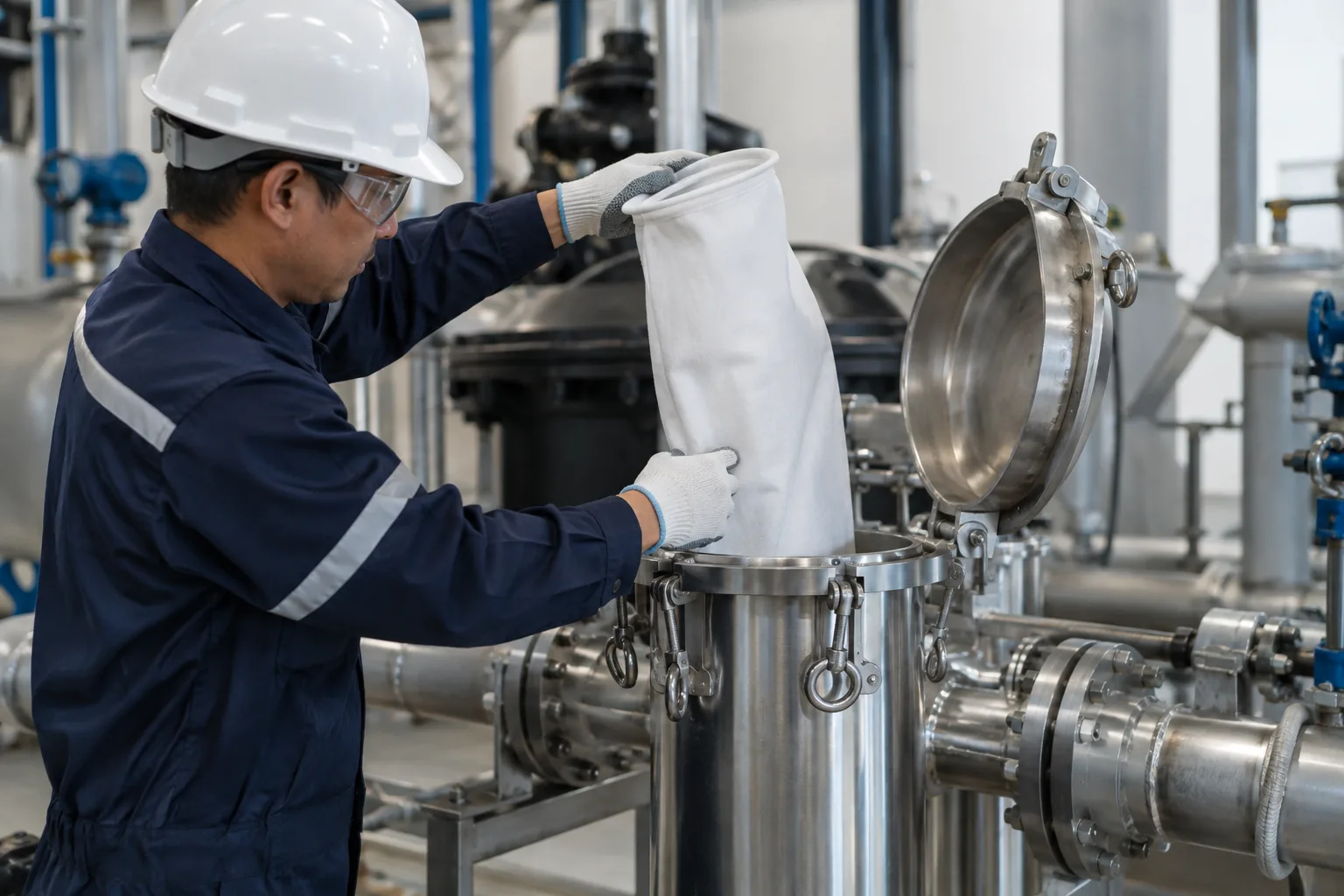
Choosing the right bag filter housing involves more than matching a flow rate to a catalogue specification. The housing, filter bag, support basket and sealing components must work together under the actual process conditions.
Seven factors deserve particular attention: design flow rate, filtration performance, bag size and compatibility, housing materials, pressure and temperature limits, housing configuration, and maintenance access.
This guide explains how to evaluate these requirements, make a preliminary sizing calculation, compare single-bag and multi-bag housings, and identify the technical information needed before requesting a quotation.
7 Key Factors to Consider When Choosing a Bag Filter Housing
1. Design Flow Rate and Filtration Capacity
Start with the liquid flow the system must handle during normal operation and at peak production demand. Selecting a housing based only on average flow can create a restriction when throughput increases or the filter bag begins collecting contaminants.
Liquid viscosity is equally important. A housing that handles water at a particular flow may experience substantially greater pressure loss when filtering viscous oils, coatings or other process liquids. Finer filter media can increase resistance further.
For this reason, a published maximum flow rate should be treated as preliminary screening information, not a guarantee of usable capacity.
The more useful comparison is the expected clean-bag pressure drop at the required design flow, under the intended operating conditions.
When comparing two candidate configurations, check whether their pressure-drop data are based on comparable:
-
Liquid viscosity and operating temperature
-
Flow rate
-
Filter bag size, media and filtration rating
-
Housing and basket configuration
-
Measurement boundaries and test conditions
A supplier may report the pressure loss of the empty housing, the filter element or the complete housing-and-bag assembly. These values are not interchangeable.
If two complete filtration assemblies provide the required retention performance, a lower initial pressure drop may leave more available operating margin before a limiting pressure condition is reached. However, it does not automatically mean the bags will last longer. Solids loading, particle characteristics and media construction also affect service life.
For preliminary evaluation, provide the normal and peak flow rates, liquid viscosity at operating temperature, and available system pressure. Request model-specific flow-versus-pressure-drop data for the proposed complete filtration arrangement, together with the assumptions used.
2. Filtration Rating and Contaminant Characteristics
The required filtration rating should follow the process objective, not simply the smallest available micron number.
A filter protecting a pump from coarse debris has different requirements from one removing fine particles before a sensitive production stage. Selecting unnecessarily fine media may increase pressure drop and shorten replacement intervals without delivering a useful process benefit.
Micron ratings also require careful interpretation.
Nominal filtration ratings do not have one universal retention-efficiency definition across all manufacturers. An absolute rating should likewise be evaluated using the supplier’s stated retention efficiency, test method and operating conditions.
Consequently, two filter bags advertised with the same micron rating may not remove the same proportion of particles.
For applications where particle retention is critical, compare the actual performance evidence rather than the micron label alone. Useful information includes the particle-size range, required removal efficiency, test conditions and the supplier’s rating definition.
Contaminant loading is another separate consideration.
A relatively clean liquid may allow a filter bag to operate for an extended interval. A stream with high suspended-solids concentration can load the media quickly, even when the housing has sufficient clean-bag flow capacity.
Particle characteristics matter as well. Fine particles, deformable solids and materials that form a dense filter cake may affect pressure-drop development differently from larger, more readily retained particles.
If loading is significant, evaluate whether greater filtration area, a different media construction or upstream solids removal would be appropriate.
The objective is to achieve the required particle retention while maintaining acceptable pressure drop, operating stability and replacement frequency.
3. Filter Bag Size and Housing Compatibility
Common industrial liquid filter bag sizes include Size #1 and Size #2.
| Filter Bag Size | Common Nominal Diameter | Common Nominal Length |
|---|---|---|
| Size #1 | 7 inches | 17 inches |
| Size #2 | 7 inches | 32 inches |
Size #2 generally provides greater nominal filtration area than Size #1 when comparable bag constructions are used.
Additional area can help reduce flow and contaminant loading per unit of media area. However, the actual improvement depends on the bag material, particle characteristics and operating conditions.
Larger bags also require sufficient housing height and removal clearance. Where overhead space is limited, a shorter bag or alternative housing arrangement may be more practical.
Physical compatibility is just as important as nominal bag size.
The filter bag collar or sealing ring must seat correctly in the housing, and the support basket must accommodate and support the bag as intended.
An incompatible sealing arrangement may allow unfiltered liquid to bypass the media, even when the bag’s micron rating is suitable.
For replacement applications, identify the existing housing model and confirm the bag dimensions, collar design, sealing arrangement and support basket.
For new installations, request the proposed housing’s compatible bag specifications and dimensional drawing.
Do not assume that bags from different manufacturers are interchangeable simply because both are described as Size #1 or Size #2.
4. Housing Material and Chemical Compatibility
SS304 and SS316 are common stainless-steel materials for industrial bag filter housings, but the appropriate material depends on the liquid chemistry and operating environment.
SS304 may be suitable for many general industrial applications. SS316 contains molybdenum, which can improve resistance to certain forms of corrosion, including chloride-induced pitting. However, SS316 is not immune to corrosion and is not suitable for every chemical concentration or exposure condition.
Material selection should consider several conditions together:
-
Process-liquid composition and chemical concentration
-
Operating and cleaning temperatures
-
Chloride content, pH and relevant corrosion conditions
-
Cleaning chemicals and exposure duration
-
Compatibility of seals, gaskets and other wetted components
For example, a housing body may be compatible with the process liquid while an unsuitable elastomer seal swells, hardens or deteriorates during service.
A material that performs adequately at ambient temperature may also behave differently at elevated temperature.
The Nickel Institute’s resources on nickel in process engineering and the British Stainless Steel Association’s corrosion guidance provide additional background on stainless-steel selection.
Example: Ruickly BFH 3 & 4 Material Options
Ruickly’s published BFH 3 & 4 single-bag filter housing specifications list SS304, SS316L and Duplex SS2205 as material options.
These are published options for the listed model. They should not be interpreted as confirmation that every Ruickly housing is available in the same materials or that each option is suitable for every process liquid.
For procurement evaluation, provide the liquid composition, relevant concentrations, operating temperature range and cleaning conditions. Ask the supplier to confirm the proposed wetted materials, seal materials and any required material documentation for the exact configuration.
5. Operating Pressure and Temperature
Operating pressure, design pressure and differential pressure describe different requirements. They should not be used interchangeably.
Operating pressure is the pressure encountered during service.
Design pressure is part of the housing’s mechanical design basis and must be evaluated with the applicable design conditions and equipment requirements.
Differential pressure (ΔP) is the pressure difference between the inlet and outlet:
ΔP = Inlet pressure − Outlet pressure
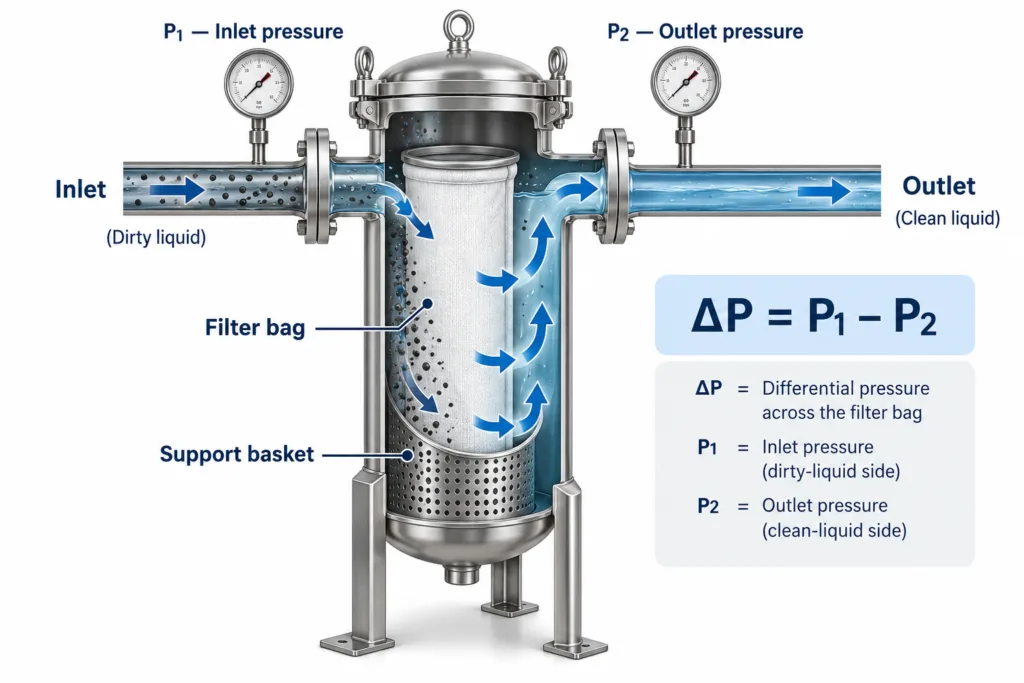
Why Initial Clean-Bag Differential Pressure Matters
The initial clean-bag pressure drop provides a baseline for evaluating the selected housing and filter bag under known operating conditions.
As contaminants accumulate, pressure drop will generally increase when flow and other relevant conditions remain comparable.
When comparing candidate assemblies, use clean-bag pressure-drop data measured or estimated at equivalent flow, viscosity, temperature and media specifications.
Also confirm whether the reported value represents the complete housing assembly or only part of it.
A lower initial pressure drop may provide more operating margin, but only when the assemblies deliver the required filtration performance and the same relevant system constraints are considered.
Why Housing Pressure Rating Is Not a Bag Changeout Limit
The housing’s mechanical pressure rating describes its pressure-containing capability under its specified design conditions.
The filter bag and support basket have separate limitations related to differential pressure.
A housing may be suitable for the system’s operating pressure while the filter bag or basket has a substantially lower allowable differential pressure.
The housing design-pressure rating must never be used as a substitute for the manufacturer’s permitted filter-bag differential pressure or recommended changeout criterion.
The usable pressure-drop margin is constrained by several factors, including:
-
The allowable differential pressure of the bag and support basket
-
The pressure available from the pumping system
-
The pressure required by downstream equipment
-
The housing’s applicable mechanical pressure limits
-
The operating and changeout criteria specified for the filtration assembly
A recommended bag-change threshold may be lower than the maximum differential pressure a component can physically tolerate.
The difference between initial pressure drop and a selected operating limit is useful for understanding available margin, but it does not independently predict bag service life.
Example: Ruickly BFH 3 & 4 Pressure and Temperature Specifications
Ruickly’s published BFH 3 & 4 product page lists:
-
Design pressure: 100 psi
-
Maximum operating pressure: 100 psi
-
Design temperature range: 0–200°C
These are manufacturer-published specifications for the listed product, not independently verified engineering test results.
They do not establish the allowable differential pressure across the filter bag, the recommended bag-change limit or the operating limits of every possible filter media and seal combination.
The final assembly must be checked against the applicable limits of all relevant components and the confirmed model configuration.
For technical evaluation, provide the normal and maximum inlet pressures, flow rate, liquid properties, temperature range and any pressure-surge conditions.
Request the proposed housing’s pressure-temperature limits, expected clean-bag pressure drop, allowable bag-and-basket differential pressure and recommended changeout criteria.
These details are more useful for selection than comparing vessel pressure ratings alone.
6. Single-Bag vs Multi-Bag Housing Configuration
The initial question is whether one filter bag can provide the required flow, retention performance and acceptable replacement interval.
If it can, a single-bag filter housing configuration may offer a simpler installation with fewer consumables per changeout.
For higher flow or heavier solids loading, additional filtration area may be needed.
A multi-bag housing allows several bags to operate within one vessel. Where the design provides suitable flow distribution, this can reduce the flow and contaminant loading assigned to each bag.
However, simply increasing the bag count does not guarantee proportional increases in usable flow capacity or service life.
The complete assembly’s hydraulic performance, available media area and flow distribution must still be evaluated.
If filtration cannot be interrupted for maintenance, the decision may involve parallel or duplex housing arrangements rather than a larger single vessel.
7. Installation, Maintenance and Accessibility
A housing that satisfies the filtration requirements must also fit the piping layout and maintenance environment.
Connection size, connection type and orientation affect installation complexity. A housing with unsuitable connections may require additional pipework or modifications.
Maintenance clearance is particularly important for top-opening housings.
There must be sufficient space to open the closure and remove the filter bag and support basket without obstruction. Longer bags and larger multi-bag vessels can require additional access space.
The expected replacement frequency should also influence the installation layout.
A housing serving a heavily contaminated process may require more frequent access to the closure, isolation valves and drainage arrangements than one filtering a relatively clean liquid.
Before purchasing, request a dimensional drawing showing the connection locations, overall envelope, closure arrangement and required maintenance clearance.
Venting, drainage and differential-pressure measurement points should be considered during the design stage. The installed orientation must follow the manufacturer’s approved configuration.
Never open or service a pressurized filter housing. Isolate, depressurize and drain the equipment as required before maintenance, following the manufacturer’s instructions and applicable lockout/tagout procedures.
How to Size a Bag Filter Housing
A preliminary bag count can be estimated once the required design flow and an appropriate allowable flow per filter bag are known.
Required number of bags = Round up (Design flow rate ÷ Allowable flow per bag)
Suppose an industrial process requires a design flow rate of 180 GPM and the assumed allowable flow per filter bag is 60 GPM.
180 GPM ÷ 60 GPM per bag = 3 bags
Under these assumptions, the preliminary requirement is three filter bags.
The 60 GPM value is illustrative only. It is not a verified Ruickly product specification or a universal filter bag capacity.
This calculation also assumes that the proposed arrangement can distribute flow appropriately and that each bag can operate at the assumed allowable flow under the intended conditions.
Meeting flow capacity does not automatically mean meeting filtration performance or achieving an acceptable bag service life.
At the same 180 GPM, a more viscous liquid or finer filter media may create greater initial pressure drop. Heavier contaminant loading may cause the bags to reach their changeout condition sooner.
An application may therefore need additional filtration area, a different media construction or another housing configuration even when the preliminary calculated bag count remains unchanged.
Final selection must be checked against the complete housing assembly’s hydraulic performance, particle-retention requirements, available pressure-drop margin, expected solids loading and manufacturer-specific technical data.
Not Sure Which Bag Filter Housing Size Fits Your Process?
Share your flow rate, filtration requirements and operating conditions with Ruickly to discuss a suitable housing configuration.
Single vs Multi-Bag Filter Housing: Which Should You Choose?
The practical differences extend beyond the number of bags. Configuration affects filtration area, hydraulic performance, maintenance arrangements and operating costs.
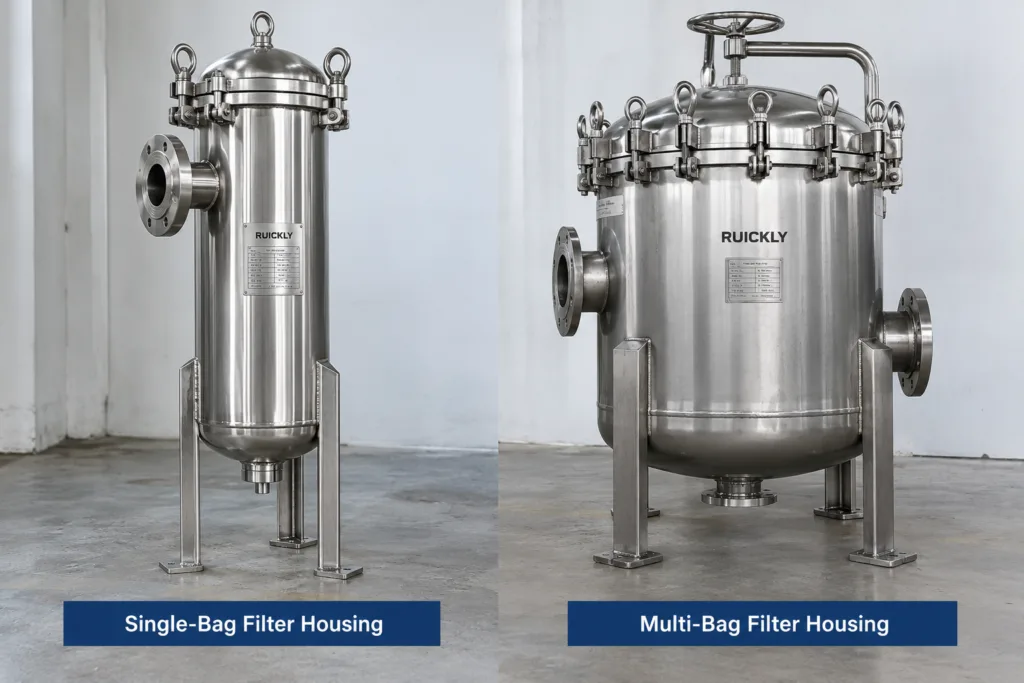
| Selection Factor | Single-Bag Housing | Multi-Bag Housing |
|---|---|---|
| Number of bags | One | Multiple |
| Flow requirements | Suitable when one bag provides adequate capacity | Suitable when greater total capacity is needed |
| Filtration area | One bag's available media area | Combined area of multiple bags |
| Installation space | Generally more compact | Generally larger |
| Solids loading | Suitable when one bag provides acceptable service life | May accommodate greater total solids loading |
| Maintenance | One bag per changeout | Multiple bags may require replacement |
| Initial equipment cost | Potentially lower for simpler duties | Often higher, depending on design |
| Continuous operation | Requires another flow path if filtration cannot stop for servicing | Also requires an appropriate parallel or duplex arrangement for uninterrupted servicing |
For moderate flow and relatively low contaminant loading, a single-bag housing may provide adequate performance without unnecessary equipment complexity.
Where one bag loads quickly, additional filtration area may extend the interval between maintenance events. The benefit should be evaluated against the cost of additional bags, maintenance labor and equipment downtime.
A multi-bag vessel does not automatically allow filtration to continue during bag replacement. If uninterrupted operation is essential, the system must provide a suitable means of maintaining flow while the relevant housing is isolated.
For procurement decisions, consider both initial equipment cost and expected operating cost. A lower-cost housing may not be the most economical choice if frequent bag changes create significant production interruptions.
Ruickly provides multi-bag filter housing configurations for applications requiring greater filtration area. Compare the available models using the actual operating conditions rather than selecting solely by bag count.
What Types of Filter Bags Are Available?
Filter bag media affects particle retention, pressure drop, chemical compatibility and service life.
Felt filter bags use fibrous media that capture particles within and across the material. They are commonly used for industrial liquid filtration and are available in different materials and filtration ratings.
Mesh filter bags use woven or structured media with defined openings. They are often suitable for coarser particle removal. Certain constructions may be cleaned and reused where the manufacturer permits it.
Multilayer or specialized filter bags combine media layers or use particular constructions to achieve specific retention and operating characteristics. Performance depends on the actual media design and process conditions.
Selecting the bag media and selecting the housing should not be treated as separate decisions.
A bag with an appropriate micron rating may still be unsuitable if its pressure-drop characteristics, chemical compatibility or sealing arrangement do not match the application.
If the process requires a different filtration mechanism, retention performance or element configuration, it may also be useful to compare Ruickly’s cartridge filter housing range.
Choosing the Right Bag Filter Housing Starts With the Application
Choosing a bag filter housing becomes easier when you start with the process rather than the product.
First, define the flow rate and filtration objective. Next, understand the liquid and operating conditions. Then, evaluate material, housing configuration, connections and maintenance requirements together.
Most importantly, avoid looking for one “best” bag filter housing for every situation. A suitable housing should match the actual filtration application and operating requirements.
Frequently Asked Questions
How do you select the right bag filter for an industrial application?
Start with the contaminants and required particle-retention performance. Compare filter media using the supplier’s stated micron-rating definition, retention data and test conditions. Then evaluate pressure drop, solids loading, chemical compatibility and the bag’s fit within the proposed housing.
Who is a leading manufacturer of bag filter housings?
There is no single manufacturer that is best for every application. Compare suppliers based on model-specific specifications, suitable material and configuration options, technical drawings, available quality documentation and support for the intended operating conditions. Ruickly is one manufacturer offering single-bag and multi-bag filter housing ranges, with published specifications for selected models. Buyers should confirm the documentation and configuration available for their project.
How do you calculate the required bag filter housing size?
Divide the design flow by the allowable flow per bag and round up to obtain a preliminary bag count. Then verify the complete assembly’s hydraulic capacity, particle-retention performance, pressure-drop limits, solids loading and expected replacement interval. The calculated number of bags alone is not a final housing specification.
What are the different types of industrial filter bags?
Common types include felt, mesh and multilayer or specialized filter bags. They differ in retention characteristics, pressure drop, chemical compatibility and cleaning or replacement requirements. The selected bag must also match the housing’s support basket and sealing arrangement.
Need a Bag Filter Housing for Your Next Project?
Choosing a housing for an industrial process requires more than matching a catalogue flow rate or selecting a stainless-steel grade.
Ruickly publishes product information for single-bag and multi-bag housings, including material and configuration options. Its BFH 3 & 4 product page provides an example of model-specific information that buyers can use for preliminary technical comparison.
For a more useful quotation discussion, provide your:
-
Design flow rate and process-liquid characteristics
-
Required filtration rating or retention performance
-
Operating pressure and temperature range
-
Connection and installation requirements
-
Expected solids loading, where known
-
Required quantity and any project-specific documentation requirements
Before approving a proposed model, ask Ruickly to confirm the applicable specifications, dimensional drawings, filter bag compatibility and available material documentation.
Where necessary, also establish whether flow-performance information, inspection records or project-specific testing documentation can be supplied.
These details help move the discussion from an initial product enquiry toward an informed technical and procurement decision.