

How to Choose an Industrial Filter Housing Supplier: A US Buyer’s Guide
Two suppliers quote stainless steel filter housings with the same nominal connection size and similar advertised flow capacities. One offers a substantially lower price. Does that make it the better purchase?
Not necessarily. The quotations may specify different material grades, cartridge arrangements, pressure limits, inspection requirements, and shipping terms. These differences affect equipment suitability, maintenance costs, and the final landed cost.
US distributors, OEM buyers, and industrial procurement teams need to assess more than the initial quotation. A suitable supplier should provide equipment specifications that match the application, relevant technical documentation, and clear arrangements for replacement elements and repeat orders.
This guide covers the technical and commercial checks involved in selecting an industrial filter housing supplier, including overseas purchasing requirements and the information needed for a request for quotation (RFQ).
How Do You Choose a Reliable Industrial Filter Housing Supplier?
Start with six checks before issuing a purchase order:
- Application fit: Confirm that the housing and filter element configuration meet the process requirements.
- Technical specifications: Verify construction materials, seals, pressure and temperature limits, and connections.
- Filtration performance: Review particle-retention requirements, hydraulic performance, and replacement-element compatibility.
- Quality documentation: Request the drawings, material records, inspection results, and test reports required for the project.
- Commercial terms: Establish delivery responsibilities, landed-cost components, and quotation exclusions.
- Repeat supply: Confirm how the supplier manages product revisions, replacement parts, and technical queries.
Assess mandatory safety and operating requirements first. A lower quotation cannot compensate for equipment that fails to meet the specified design conditions.
Start With the Right Filter Housing for Your Application
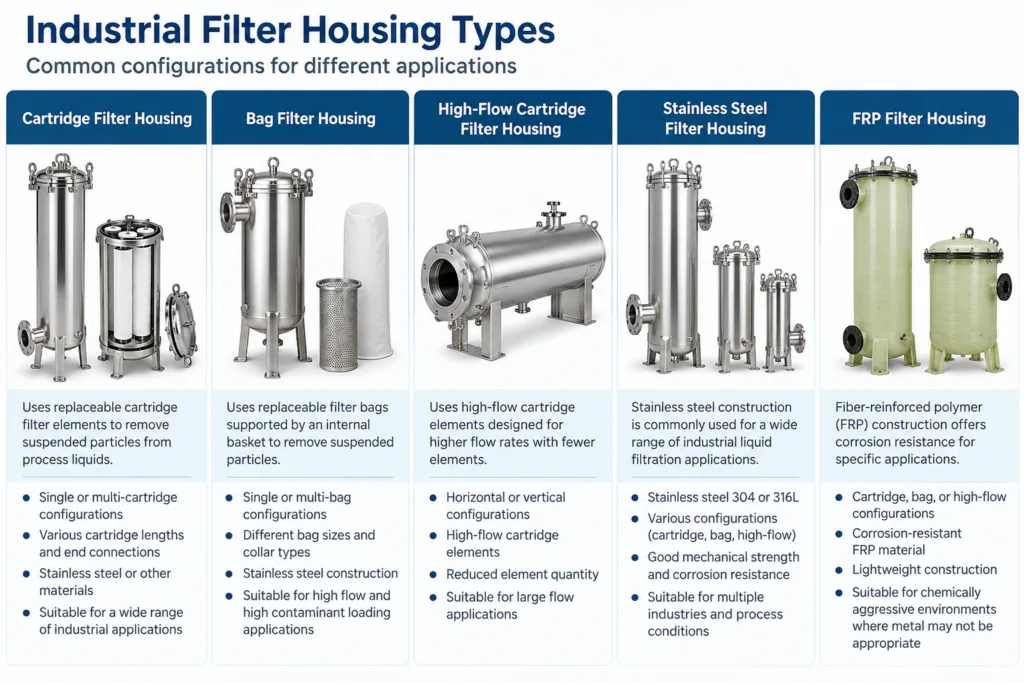
Filter housing configuration and construction material are separate selection criteria. Cartridge and bag housings describe the filtration arrangement, while stainless steel and fiber-reinforced polymer (FRP) describe construction materials.
A cartridge housing, for instance, may use stainless steel or another suitable material, depending on the equipment design and process conditions.
Cartridge Filter Housing
Cartridge filter housings hold replaceable filter elements that remove suspended particles from process liquids.
When selecting a cartridge housing, check the cartridge dimensions, end connections, retention efficiency, flow requirements, contaminant loading, and available maintenance space.
Do not assume that cartridges with identical nominal micron ratings deliver the same retention performance. Ask the supplier to identify the rating definition, test method, and operating conditions used to establish the specification.
Explore Ruickly’s cartridge filter housing range to review available configurations, including single- and multi-cartridge models.
Bag Filter Housing
Bag filter housings hold replaceable filter bags inside a supporting basket or equivalent internal arrangement.
Their suitability depends on the required particle retention, contaminant loading, filter media, and maintenance conditions.
Check the bag size, collar design, sealing arrangement, basket construction, and expected operating pressure drop. These details influence replacement compatibility and maintenance requirements.
Bag filtration does not necessarily cost less than cartridge filtration. Compare consumable usage, replacement frequency, labor, and process downtime before selecting either arrangement.
Ruickly offers single-bag filter housings and multi-bag filter housings. Confirm the proposed bag configuration, capacity, and operating limits against your application requirements.
High-Flow Cartridge Filter Housing
High-flow cartridge housings accommodate filter elements designed for relatively high liquid flow rates.
Some configurations achieve the required flow with fewer elements than conventional multi-cartridge arrangements. However, the actual element quantity depends on the selected cartridge design, fluid properties, and filtration requirements.
Check the cartridge dimensions, flow direction, inlet and outlet connections, allowable element differential pressure, and clearance needed for element replacement.
Ruickly’s high-flow cartridge filter housing options include horizontal and vertical configurations for different installation requirements.
Stainless Steel Filter Housing
Stainless steel housings provide metallic construction for industrial liquid filtration applications where the selected grade meets the mechanical and chemical requirements.
Material selection matters. Stainless steel 304 and 316L differ in composition and corrosion resistance, and neither grade suits every process liquid.
Specify the required material grade and verify the materials of all relevant wetted components, including seals and connections.
For applications involving chlorides or aggressive chemicals, assess corrosion risks under the actual operating conditions rather than relying on the general description “stainless steel.”
FRP Filter Housing
Fiber-reinforced polymer (FRP) housings offer an alternative to metallic construction for applications where the selected composite system provides suitable chemical resistance and mechanical performance.
FRP properties depend on the resin system, reinforcement, liner, manufacturing method, and equipment design.
Before selecting an FRP housing, verify its chemical compatibility and pressure-temperature limits against the intended process conditions.
Review Ruickly’s FRP filter housing range when assessing composite filtration equipment, including cartridge, bag, and high-flow configurations.
Match the Housing to the Process
Give the supplier enough operating information to evaluate the proposed equipment.
At a minimum, identify the process liquid and its composition, normal and peak flow rates, filtration objective, contaminants, operating temperature, and pressure conditions.
Include connection requirements, installation dimensions, maintenance clearance, and preferred replacement elements where relevant.
Without these details, a supplier cannot reliably determine whether a published maximum flow rating applies to the intended process.
Six Things to Check Before Choosing a Filter Housing Supplier
1. Technical Fit
A supplier should identify a housing configuration that meets the stated process conditions and explain any limitations that require further engineering review.
Check that the quotation specifies the proposed housing model, filter element arrangement, materials, operating limits, and connection details.
Pay particular attention to pressure terminology.
Housing pressure rating, filter element differential pressure, and complete assembly pressure drop describe different operating parameters.
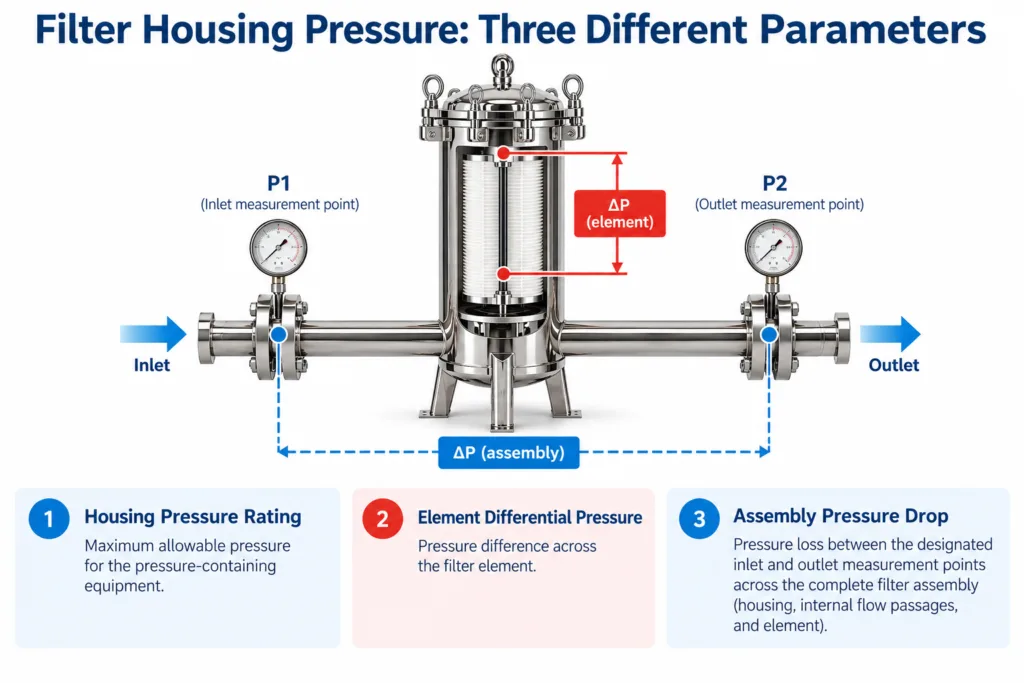
The housing pressure rating relates to the pressure-containing equipment and its specified design conditions.
Filter element differential pressure is the pressure difference across the filter element itself.
Complete assembly pressure drop is the pressure loss between designated upstream and downstream measurement points across the installed filtration assembly.
Consider a process with a maximum permitted assembly pressure drop of 15 psi, measured between specified inlet and outlet points at a defined flow rate, temperature, and fluid viscosity. The cartridge manufacturer separately specifies a maximum allowable element differential pressure of 20 psi under its applicable conditions.
The two limits serve different purposes.
The assembly measurement may include pressure losses through the housing and internal flow passages, in addition to the filter element. Therefore, an assembly pressure-drop reading of 15 psi does not establish that the element itself has reached 15 psi differential pressure.
The process may require corrective action when the assembly reaches its 15 psi operating limit, even if the cartridge remains below its allowable differential pressure. Conversely, operators must not exceed the element’s differential-pressure limit simply because the process can tolerate a higher overall pressure loss.
Ask the supplier to identify the relevant measurement points, expected clean-element and assembly pressure drops, and recommended replacement criteria under defined operating conditions.
2. Materials and Construction
Verify the construction materials of the housing body, connections, seals, and other relevant wetted components.
Descriptions such as “stainless steel” or “FRP” do not provide enough information for a complete chemical compatibility assessment.
Request material grades, resin or liner details where applicable, and the relevant construction specifications.
For customized equipment, confirm that the final approved drawings and material records reflect the agreed changes.
3. Filtration Performance
Establish the particle-retention performance required by the application.
Nominal and absolute micron ratings may use different definitions and test methods. Compare the stated retention efficiency and supporting test conditions rather than relying on micron ratings alone.
Where particle removal is critical, request relevant performance data for the proposed filter elements.
Also review hydraulic performance at the specified flow rate, temperature, and fluid viscosity.
The supplier should identify the element’s allowable differential pressure and recommend an appropriate replacement criterion.
If the installed instruments measure pressure drop across the complete housing assembly, clarify how operators should interpret those readings when assessing element loading.
4. Quality Documentation and Testing
Quality-management certification does not replace equipment-specific technical documentation.
ISO 9001 addresses a supplier’s quality management system. It does not independently verify a particular filter housing’s pressure rating, material composition, or compliance with a pressure-equipment design code.
When checking a supplier’s ISO 9001 certificate, confirm the legal entity, manufacturing site, certificate number, validity, and certification scope.
Where possible, verify the certificate through the issuing certification body or an appropriate recognized database.
The ISO 9001 standard provides the underlying quality-management framework.
Depending on the project, request approved drawings, material records, inspection and test plans, dimensional inspection reports, pressure or leakage test results, and traceability information.
Review whether the documents apply to the quoted model and, where relevant, the equipment delivered.
A test report should identify the equipment tested, test conditions, acceptance criteria, results, and authorization.
Pressure-equipment requirements vary by design and installation. The ASME Boiler and Pressure Vessel Code provides a relevant framework where applicable, but buyers should not assume that every industrial filter housing requires the same code certification.
5. Consumables and Long-Term Cost
The initial equipment price represents only part of the purchasing cost.
Replacement cartridges or bags, seals, maintenance labor, changeout frequency, and downtime can affect long-term expenditure.
Confirm the replacement elements’ dimensions, sealing arrangements, and ordering references.
If the housing uses proprietary elements, establish their availability, pricing, and future sourcing arrangements before placing an order.
Filter life varies with contaminant loading, filter media, flow conditions, viscosity, and process requirements. Avoid using unsupported service-life estimates to compare suppliers.
6. Supply and Technical Support
Assess how the supplier handles technical queries, drawing approvals, order changes, and repeat purchases.
Distributors and OEM buyers should establish how the supplier controls specifications and product revisions between production batches.
Clarify who takes responsibility for manufacturing, inspection, technical approval, and warranty decisions.
These arrangements become particularly important when a buyer plans to supply the same housing configuration across multiple projects or customer orders.
Should You Buy From a Manufacturer, Distributor, or System Integrator?
The choice between a manufacturer, distributor, and system integrator often depends on order volume, engineering requirements, and the level of local support needed.
Manufacturer: Direct sourcing may suit buyers who require specific equipment configurations, repeat production, or volume purchasing. Confirm who controls manufacturing, technical drawings, inspections, and design approvals.
Distributor: A distributor may offer purchasing convenience, smaller order quantities, local stock, or access to replacement elements. However, these services vary. Verify actual inventory, product traceability, technical support, and warranty responsibilities.
System integrator: Projects involving pumps, piping, controls, and complete filtration systems may require an integrator to coordinate equipment selection, system design, installation, and commissioning. Confirm which engineering and site activities the quoted scope includes.
Direct manufacturer sourcing does not automatically produce a lower delivered cost. Compare the equipment specification, support responsibilities, supply arrangements, and total purchasing cost before choosing a sourcing channel.
Should You Buy From a Manufacturer, Distributor, or System Integrator?
The appropriate sourcing channel depends on what the buyer needs beyond the equipment itself.
Manufacturer: May be suitable for OEM specifications, technical discussions, repeat orders, and volume sourcing. Verify who controls production, drawings, inspection, and technical approval.
Distributor: May be useful for smaller orders, local inventory, replacement-element access, or domestic service, depending on the distributor’s actual capabilities. Confirm product traceability, availability, and warranty responsibilities.
System integrator: May be preferable when the project requires filtration equipment to be designed or installed as part of a complete system involving pumps, piping, controls, and other components. Confirm the integrator’s engineering and commissioning scope.
Buying directly from a manufacturer is not automatically cheaper or better. Compare the actual responsibilities, documentation, support, and delivered cost of each option.
Warning Signs When Evaluating a Filter Housing Supplier
Several gaps in a quotation warrant clarification before purchase:
- Incomplete material specifications: The supplier does not identify the housing material grade, seal material, or relevant wetted components.
- Unsupported flow ratings: The quoted maximum flow rate lacks the corresponding fluid properties, filter configuration, or pressure-drop conditions.
- Unclear replacement-element compatibility: The supplier cannot confirm cartridge or bag dimensions, end connections, or sealing arrangements.
- Undefined inspection requirements: The quotation does not specify which inspections or test records the supplier will provide.
- Uncontrolled design changes: Revised connections, dimensions, or materials do not appear in the approved drawings.
- Unclear delivery responsibilities: The quotation omits important shipping terms, warranty conditions, or delivery exclusions.
These gaps do not automatically disqualify a supplier. However, buyers should resolve any issues affecting safety, technical suitability, or contractual responsibility before issuing a purchase order.
How to Compare Filter Housing Quotations Without Choosing on Price Alone
Two filter housings may have similar connection sizes and advertised flow capacities without being suitable substitutes. Differences in construction materials, cartridge dimensions, pressure ratings, and hydraulic performance can determine whether either unit meets the application’s requirements.
Compare each quotation against the same operating conditions. Where a specification affects safety, filtration performance, or maintenance, request supporting documentation rather than relying solely on the supplier’s product description.
Industrial Filter Housing Quotation Comparison Checklist
| Specification | What to Verify | Documentation to Request |
|---|---|---|
| Housing configuration | Cartridge or bag arrangement, element quantity, orientation, and maintenance access | General arrangement drawing and model specification |
| Materials of construction | Housing body, wetted components, gasket materials, and compatibility with the process fluid | Material specifications and applicable material records |
| Pressure and temperature limits | Design conditions, allowable operating limits, and temperature-dependent restrictions | Technical datasheet and applicable design documentation |
| Hydraulic performance | Expected assembly pressure drop at the specified flow rate, temperature, and fluid viscosity | Pressure-drop curves or documented performance calculations, where available |
| Filter element compatibility | Cartridge or bag dimensions, end connections, sealing arrangements, and replacement-element availability | Element specifications and compatibility details |
| Connections and dimensions | Inlet/outlet type, connection size, installation footprint, and element removal clearance | Dimensional drawing and connection details |
| Inspection and testing | Required inspections, pressure or leakage testing, and acceptance criteria | Inspection and test records applicable to the quoted equipment |
| Delivery and commercial terms | Lead-time basis, Incoterms, shipping scope, warranty, and replacement-part arrangements | Itemized quotation and agreed commercial terms |
Resolve Technical Differences Before Comparing Prices
A published maximum flow rating does not establish equipment suitability. The supplier must assess hydraulic performance using the proposed filter elements and relevant fluid properties.
Likewise, a housing’s pressure rating does not establish the allowable differential pressure across its filter elements. Verify both limits against the intended operating conditions.
If quotations specify different material grades, filter element arrangements, or documentation packages, resolve those differences before comparing prices.
Account for additional inspection requirements, replacement components, freight, and other applicable costs when assessing the total purchase.
For repeat orders, distributors and OEM buyers should also confirm how the supplier will maintain approved specifications and replacement-element references.
Send Your Filter Housing Specifications to Ruickly to discuss available configurations and quotation requirements.
Buying Filter Housings From an Overseas Manufacturer: A Checklist for US Buyers
US distributors and OEM buyers sourcing filter housings internationally must account for import responsibilities, shipping arrangements, customs documentation, and repeat-order requirements.
Review these conditions before accepting a quotation, particularly when comparing overseas suppliers with domestic purchasing options.
Confirm Shipping Terms and Landed Cost
Ask the supplier to identify the agreed Incoterms rule and named place.
An EXW quotation, for instance, cannot be compared directly with a quotation that includes international freight or delivery to a specified destination.
Establish:
- Who arranges export transportation and international freight.
- Who pays for insurance and destination handling.
- Who acts as the US importer of record.
- Who manages customs entry and brokerage.
- Which transportation and handling costs the quotation includes.
- Where delivery obligations end and risk transfers under the agreed terms.
Calculate the estimated landed cost using the equipment price, transportation, applicable insurance, duties, brokerage, and destination charges.
Review Customs and Import Documentation
Request the commercial invoice, packing list, country-of-origin information, and applicable shipping documents.
The US importer should confirm the correct Harmonized Tariff Schedule classification and duty treatment for the specific equipment.
Additional duties or trade measures may apply depending on the product classification, country of origin, and regulations in effect at the time of import.
Consult the US International Trade Commission’s Harmonized Tariff Schedule for tariff information and US Customs and Border Protection for import guidance.
Customs clearance does not establish that the equipment meets every technical or regulatory requirement for its intended installation.
Check Export Packaging
Ask the supplier how it protects openings, connections, sealing surfaces, and exposed components during transportation.
For large or heavy housings, confirm the packaging method, lifting provisions, and handling requirements.
Consistent packaging specifications also help distributors inspect incoming equipment across repeat shipments.
Confirm OEM and Customization Requirements
If the project requires modifications, provide the relevant drawings, material specifications, connection details, labeling requirements, and dimensional constraints.
Ask the supplier to identify which changes require engineering review and final drawing approval.
For repeat orders, reference the approved model number, drawing revision, material specifications, and agreed modifications on the purchase order.
Plan for Replacement Elements and Repeat Supply
Confirm the replacement cartridges’ or bags’ dimensions, sealing arrangements, product references, and availability.
Where the equipment requires proprietary elements, clarify how buyers can obtain replacements throughout the intended service period.
Distributors should also establish how the supplier will manage specification changes between orders.
Define Warranty and Delivery Responsibilities
Review the warranty scope, exclusions, and procedure for reporting nonconforming equipment.
Confirm when the supplier starts counting the quoted lead time. Depending on the agreed terms, this may follow purchase-order acceptance, payment arrangements, or final drawing approval.
Document the procedures for reporting shipping damage, shortages, and technical discrepancies.
What Information Should You Include in a Filter Housing RFQ?
A useful RFQ identifies the operating requirements and purchasing conditions that affect equipment selection.
You do not need to complete every engineering detail before contacting a supplier. Provide the available information and ask the supplier to identify what else it needs for a technical assessment.
Industrial Filter Housing RFQ Checklist
- Application: Process description and filtration objective.
- Process liquid: Fluid composition, relevant chemicals, contaminants, and viscosity.
- Flow: Normal and peak operating rates.
- Temperature: Normal and maximum operating temperatures.
- Pressure: Normal and maximum operating pressure and required housing design conditions.
- Pressure drop: Maximum acceptable clean-assembly pressure drop and dirty-assembly operating limit, where applicable.
- Filter element limits: Maximum allowable element differential pressure and preferred changeout criterion, if known.
- Filtration performance: Micron rating, retention-efficiency requirements, and test basis.
- Housing configuration: Cartridge, bag, or high-flow arrangement and preferred orientation.
- Materials: Housing construction, wetted components, and seal requirements.
- Connections: Inlet/outlet size, type, and orientation.
- Dimensions: Installation space, maintenance clearance, and available drawings.
- Documentation: Required drawings, material records, inspections, testing, and applicable standards.
- Order details: Quantity, replacement elements, delivery destination, and preferred shipping terms.
For pressure-drop requirements, specify whether each limit applies to the complete assembly or the filter element.
Identify the relevant measurement points and operating flow rate, temperature, and viscosity.
If the instrumentation arrangement has not been finalized, ask the supplier how the proposed system should monitor element loading and determine replacement limits.
Additional Information for Distributor and OEM Inquiries
Wholesale, distributor, and OEM buyers should also provide:
- Product types and sizes of interest.
- Estimated initial order quantity.
- Expected repeat-order volume, if known.
- OEM branding or labeling requirements, where applicable.
- Required drawings and documentation.
- Replacement cartridge or bag requirements.
- Target US delivery destination.
- Customization requirements.
These details help the supplier establish the quotation scope and identify which technical or commercial arrangements require further confirmation.
Why Consider Ruickly for Your Filter Housing RFQ?
Ruickly offers industrial liquid filtration equipment options covering cartridge, bag, FRP, and self-cleaning filtration systems.
Its published product range includes several configurations relevant to industrial liquid filtration procurement:
- Cartridge filter housings — Single- and multi-cartridge models, including sanitary configurations. The range includes stainless steel construction and options for different connections and cartridge arrangements.
- Bag filter housings — Single-bag models, alongside multi-bag filter housings for applications requiring greater filtration capacity.
- High-flow cartridge filter housings — Horizontal and vertical configurations for different installation requirements.
- FRP filter housings — Cartridge, bag, and high-flow configurations using fiber-reinforced polymer construction.
Buyers should confirm the material grade, dimensions, pressure-temperature limits, element compatibility, and documentation available for the specific model before ordering.
Distributors and OEM buyers can use these product categories to identify potential configurations before requesting a detailed quotation.
If your application requires specific materials, connection arrangements, cartridge dimensions, or installation clearances, send Ruickly the relevant operating conditions and available drawings.
Our team can review the published product options and clarify the technical specifications, drawings, material details, and quality documentation available for the proposed configuration.
Equipment suitability, customization feasibility, and commercial terms must be confirmed for each inquiry.
Frequently Asked Questions (FAQs)
What is the difference between a filter housing manufacturer and a distributor?
A manufacturer produces equipment directly or through its manufacturing arrangements. A distributor supplies equipment from manufacturers and may offer local inventory, purchasing support, or replacement-element access. Buyers should verify each company’s actual manufacturing, technical, and warranty responsibilities.
Can I compare industrial filter housings based on micron rating alone?
No. Micron ratings do not establish equivalent filtration performance unless the stated retention efficiency and test conditions are comparable. Buyers must also consider element configuration, hydraulic performance, and process compatibility.
What documents should I request from a filter housing supplier?
Request the documents relevant to the equipment and project requirements. These may include approved drawings, material specifications, operating limits, inspection records, test reports, and installation instructions. Confirm any required certifications or design-code documentation before ordering.
What should US buyers confirm before importing filter housings?
Check the agreed Incoterms, importer-of-record responsibilities, customs documentation, country of origin, applicable duties, packaging, and delivery arrangements. Buyers must also establish whether the equipment meets the requirements of its intended installation.
What information is needed for an OEM filter housing quotation?
Provide the intended application, operating conditions, proposed housing configuration, materials, dimensions, order quantity, and documentation requirements. Include anticipated repeat volumes, branding specifications, and requested modifications where applicable.
Final Thoughts: Choose a Supplier Based on Technical and Commercial Requirements
Before issuing a purchase order, confirm that the proposed filter housing meets the operating requirements and that the agreed specifications, inspection records, and delivery responsibilities are documented.
US distributors and OEM buyers should pay particular attention to replacement-element availability, repeat-order consistency, and landed cost.
Request a Filter Housing Quotation from Ruickly with your flow rate, process conditions, filtration requirements, order quantity, and delivery destination.
For distributor, wholesale, or OEM inquiries, include the intended product range, estimated purchasing volume, and any customization requirements.