
Choosing a Multi Bag Filter Housing Manufacturer for Continuous Filtration in Texas
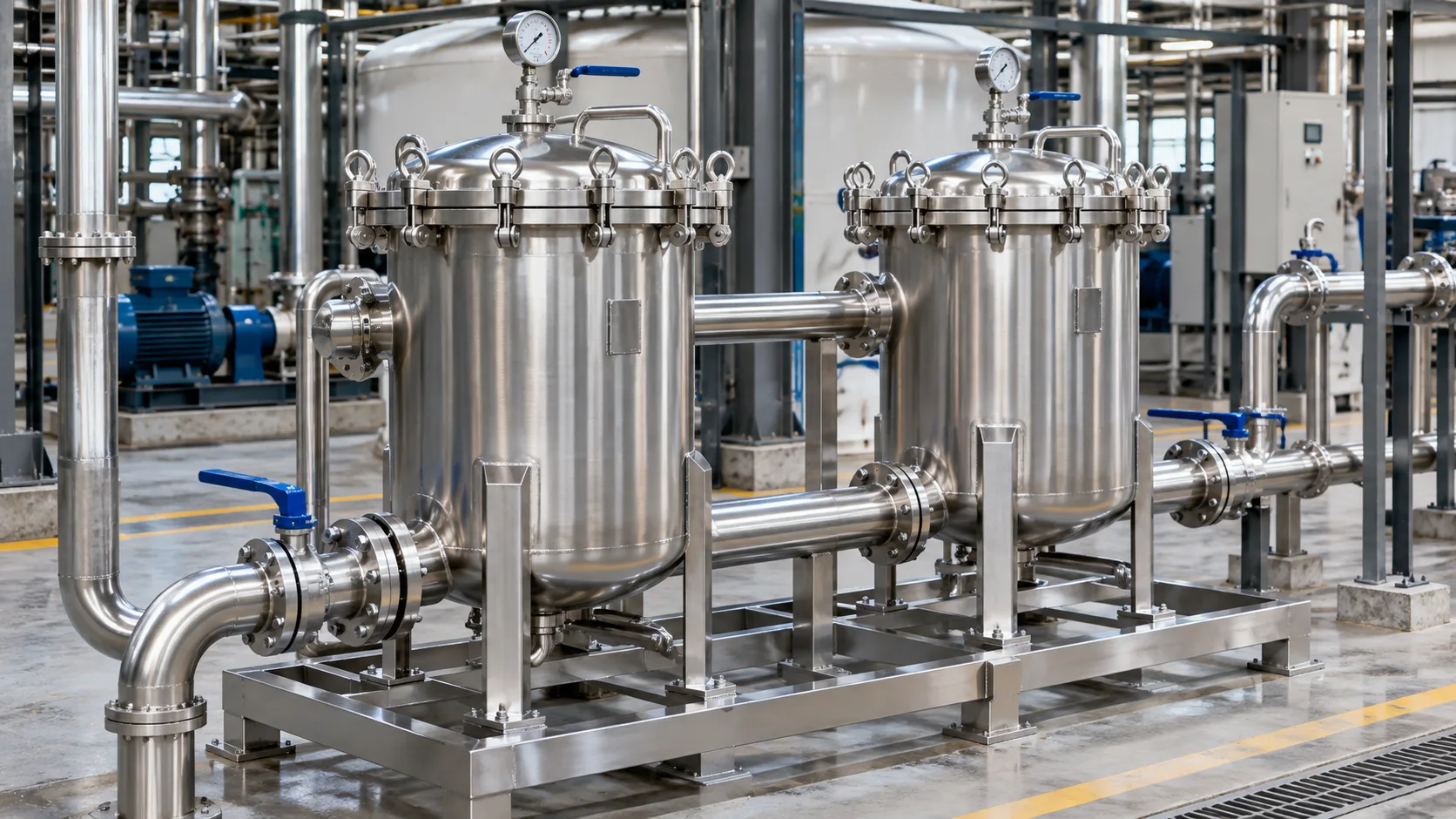
When sourcing industrial filter housings in Texas, choose a multi bag filter housing manufacturer that can demonstrate whether the proposed system can maintain the required flow while a housing is unavailable for maintenance. A vessel containing several filter bags may handle a larger flow or solids load than a single-bag vessel, but it does not automatically provide uninterrupted filtration during bag replacement.
This distinction matters in process-water treatment, chemical manufacturing and other operations where a filtration interruption can affect downstream equipment or production. Compare the required flow, allowable pressure drop, alternative filtration paths, maintenance access and documentation before deciding how many vessels to purchase.
This guide explains how to evaluate multi-bag arrangements for continuous filtration, compare their practical limitations and prepare a more precise request for quotation (RFQ). The numerical scenarios are illustrative engineering examples rather than published Ruickly equipment ratings.
Can a multi-bag filter housing maintain continuous filtration during bag replacement?
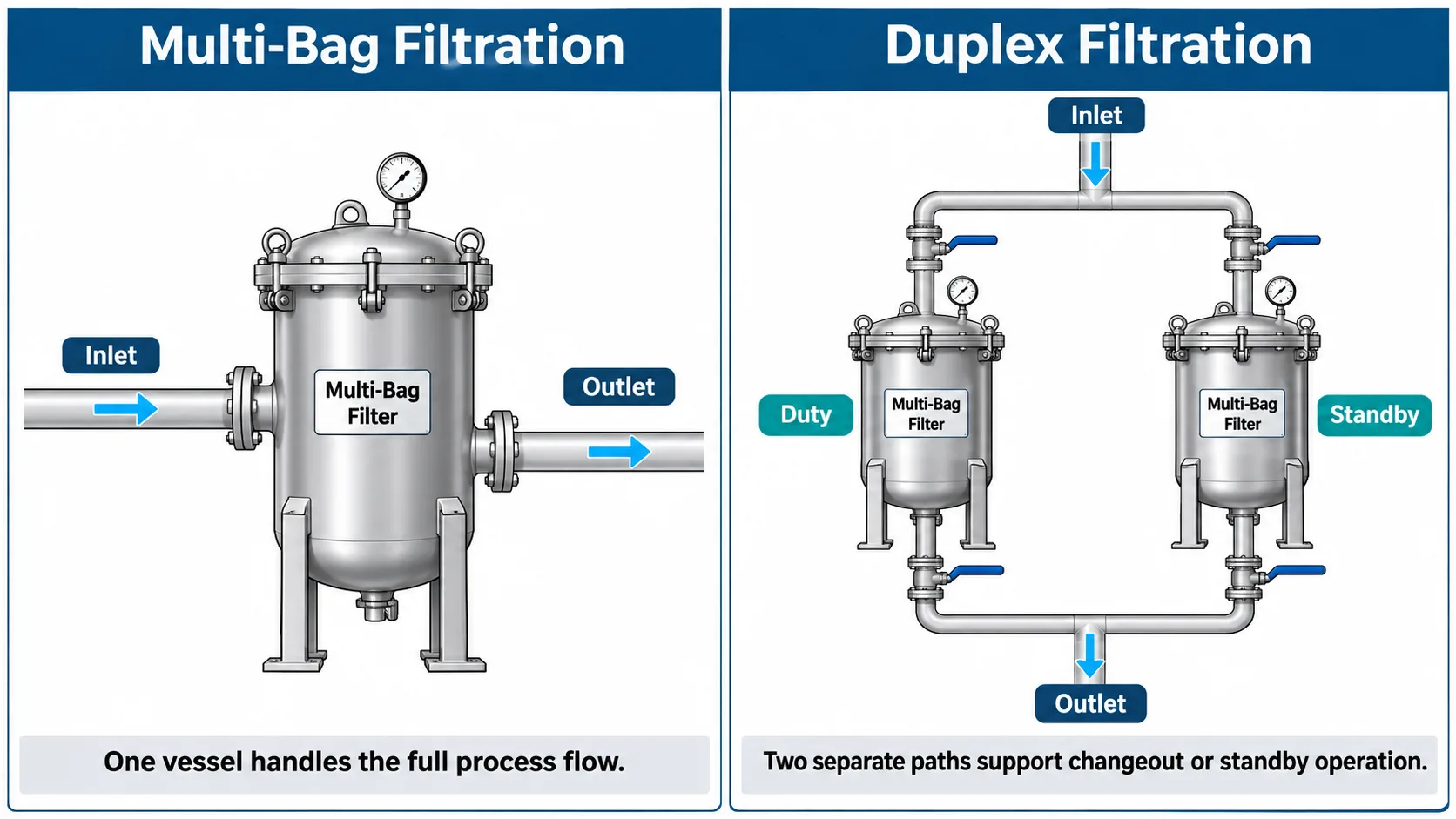
Not by itself. A multi-bag housing contains several filter bags within a common vessel. Its internal arrangement allows the liquid to pass through multiple filtration elements, potentially increasing the available filtration area and contaminant-holding capacity. Nevertheless, when the vessel requires internal servicing, its multiple bags do not constitute independent filtration paths that can safely remain pressurized while the cover is open.
To maintain filtration during a changeout, the plant generally needs another adequately sized filtration path or a validated process arrangement that accommodates the interruption, such as suitable buffer storage. A separate vessel may remain in service while authorized personnel service an isolated vessel under the site’s approved procedures. The complete system must maintain the required downstream quality and hydraulic conditions.
Ruickly offers multi bag filter housing configurations for higher-flow industrial liquid filtration. When evaluating these products, distinguish the capacity of each vessel from the availability of the entire filtration system. Confirm whether a complete manifolded or duty/standby arrangement falls within the manufacturer’s proposed supply scope.
Single-vessel, parallel and duty/standby filtration: which arrangement fits your process?
Start by identifying the minimum flow that downstream equipment requires during production and the duration for which that equipment can tolerate a filtration interruption. These constraints help determine whether one multi-bag vessel is adequate or whether the process requires additional independently serviceable vessels.
| Arrangement | Normal operation | During vessel maintenance |
|---|---|---|
| One multi-bag vessel | Several bags share filtration duty inside one housing. | Requires a planned interruption or another suitable filtration path. |
| Two parallel vessels sharing the load | Both vessels contribute to the total operating flow. | Remaining capacity may be insufficient if one vessel is unavailable. |
| Duty/standby (duplex) arrangement | One vessel performs the required duty and the other remains available as an alternative. | May sustain the design flow if either vessel can meet the full duty and the system supports a safe transfer. |
| N+1 parallel arrangement | The installation has one additional unit beyond the number required to meet the design duty. | May maintain the required flow with one unit unavailable, subject to hydraulic and control verification. |
The term duplex in a filtration layout refers to two serviceable filtration paths. It does not mean that the vessels necessarily use duplex stainless steel. Buyers should describe the desired operating arrangement and material separately to avoid ambiguity in quotations.
For a batch process with scheduled shutdowns, one multi-bag vessel may offer sufficient capacity without the cost and complexity of additional pipework. For a plant that cannot interrupt the supply of filtered process water, a redundant configuration deserves further evaluation. Smaller duties may also suit single bag filter housings if the complete system meets the required performance.
How do you size multi-bag filter housings for operation with one vessel offline?
Calculate the required flow under both normal and maintenance conditions. A system that delivers the full production flow only when all vessels operate may not meet an uninterrupted-filtration requirement.
Compare the available filtration capacity
Consider a hypothetical Texas manufacturing facility that requires 300 U.S. gallons per minute (GPM) of filtered process water, approximately 68.1 m³/h. Assume that engineering has verified an allowable flow of 150 GPM for one candidate vessel at the specified liquid properties, filter media and pressure-drop limits. An alternative larger vessel can handle 300 GPM under those same stated conditions.
| Illustrative configuration | Aggregate capacity with all available | Capacity with one unavailable | Meets 300 GPM requirement? |
|---|---|---|---|
| 1 × 300 GPM | 300 GPM | 0 GPM | No |
| 2 × 150 GPM | 300 GPM | 150 GPM | No |
| 2 × 300 GPM (duty/standby) | 600 GPM combined nominal availability; 300 GPM design duty | 300 GPM | Potentially, subject to system verification |
| 3 × 150 GPM (N+1) | 450 GPM | 300 GPM | Potentially, subject to system verification |
The figures show preliminary aggregate capacities, not guaranteed installed flow rates. The pump curve, manifold resistance, branch-flow distribution, valve arrangement, filter loading and downstream pressure requirements determine the actual performance. The larger combined capacity does not mean that the process must operate at that flow during normal production.
Ask the manufacturer to provide hydraulic data for the proposed vessels and have the system designer verify the one-vessel-unavailable condition. If the remaining filters cannot meet the required flow without exceeding their limits, reconsider the arrangement rather than relying on a higher pump pressure.
Account for pressure drop as filter bags load
Pressure drop describes the difference between the pressure upstream and downstream of the filtration assembly. As the media collects solids, its hydraulic resistance can increase. Consequently, a vessel that meets the design flow with clean bags may no longer deliver that flow as it approaches its permitted changeout condition.
For example, suppose the measured clean assembly pressure drop is 4 psi differential (4 psid) at the design flow, and the engineering review establishes a maximum allowable assembly differential of 12 psid for this hypothetical duty. The initial differential-pressure margin is 8 psid. These values are assumptions for the example, not recommended alarm or changeout settings.
Do not confuse the housing’s internal pressure rating, often expressed in psig, with the allowable differential pressure across the bag, support basket or assembly. A high vessel pressure rating does not establish an acceptable filter-media differential. Request the complete assembly pressure-drop data, the media and basket limits, and the intended monitoring and changeout criteria. The permitted operating differential may be lower than the vessel rating for several reasons, including downstream pressure requirements.
The supplier should also identify the fluid viscosity, temperature, filtration rating and solids-loading assumptions behind any capacity figure. Refer to our bag filter housing selection guide for the broader relationship between filter area, flow and media compatibility.
What should Texas facilities specify for safe maintenance and reliable changeouts?
Continuous production does not justify servicing a vessel while it remains pressurized or exposed to hazardous energy. Procurement teams should request drawings that enable qualified site personnel to assess independent isolation, residual-pressure control, drainage, venting, maintenance clearances and the prevention of inadvertent re-pressurization. A quick-opening cover does not replace an engineered isolation arrangement.
The U.S. Occupational Safety and Health Administration’s control of hazardous energy standard, 29 CFR 1910.147, addresses servicing and maintenance where unexpected energization or the release of stored energy can injure employees, within its scope and exceptions. The employer must determine the applicable requirements and implement appropriate energy-control procedures. Never open a filter housing that remains pressurized or otherwise unsafe to service.
Before approving a layout, involve the plant’s engineering, maintenance and safety teams. Evaluate the following procurement requirements rather than using a generic valve-switching sequence:
- Isolation and control design: Confirm which equipment and control functions fall within the supplier’s scope and which the site designer must provide.
- Pressure monitoring: Request the appropriate measuring points and instrument range for identifying filtration resistance, operating pressure and relevant abnormal conditions.
- Access and handling: Check space for the cover, baskets, saturated bags and any lifting assistance required by the maintenance procedure.
- Containment and disposal: Determine how maintenance personnel will manage retained process liquid and contaminated media under applicable site and environmental procedures.
- Consumables: Verify bag dimensions, retention performance, media chemistry, sealing interface and availability of replacement bags and gaskets.
For installations around the Texas Gulf Coast, assess external exposure to humidity, airborne salts and chemical contaminants separately from the process fluid inside the vessel. Confirm the suitability of the selected stainless steel grade, surface treatment and sealing materials at the actual pressure and temperature. Ruickly’s Texas product page identifies stainless steel and non-metallic options for different process requirements; the availability and suitability of any particular material must be confirmed for the proposed model.
Which documentation should a multi bag filter housing manufacturer provide?
Request enough model-specific information for engineering and procurement to evaluate the vessel and the complete filtration arrangement before committing to a purchase. A product photograph, nominal flow rating or general statement about stainless steel construction cannot establish that an installation meets the required duty.
For U.S. projects with pressure-equipment requirements, verify the applicable design code, jurisdictional requirements and purchaser specifications with the responsible engineering and compliance personnel. The ASME Boiler and Pressure Vessel Certification program explains the certification framework for pressure equipment, including Section VIII vessel certification scopes. If the project requires an ASME Certification Mark or particular documentation, request written confirmation that the offered vessel can satisfy the specified requirements. Do not assume that all industrial filter housings require the same certification or that every Ruickly model carries an ASME mark.
Use the following RFQ checklist to clarify the manufacturer’s deliverables and outstanding engineering decisions.
| Decision area | What to request | Proceed when |
|---|---|---|
| Process performance | Normal, peak and minimum maintenance flow; liquid properties; filtration objective and hydraulic data. | The documented configuration meets the duty in normal and required maintenance conditions. |
| Vessel and media | Bag count and dimensions, wetted materials, support baskets, seal details, pressure and temperature limits. | Engineering accepts the model-specific compatibility and operating limits. |
| System integration | Dimensional drawings, connection standards, manifold scope, pressure-monitoring provisions and control interfaces. | The system designer can verify the proposed layout and responsibilities. |
| Maintenance and safety | Applicable manuals, closure and access requirements, isolation provisions and spare-parts list. | The site can develop and approve suitable maintenance procedures. |
| Quality and conformity | Applicable material, inspection and test records; required code documentation and marking, if applicable. | The documentation matches the quoted model and project requirements. |
| Texas delivery and support | Delivery location, freight terms, lead time, import responsibilities, spare availability and technical contacts. | Commercial responsibilities and supply arrangements are confirmed in writing. |
When is the additional cost of redundant filtration justified?
Compare the lifecycle implications of additional vessels with the potential cost of interrupting production. Redundancy increases equipment, pipework, instrumentation and maintenance requirements, but it may provide value when bag changeouts otherwise interrupt a critical process.
For example, assume a plant experiences 24 scheduled filter-service events per year, each causing 45 minutes of production interruption. If the estimated lost contribution is $800 per hour, these events represent 18 hours and $14,400 in illustrative annual lost contribution. A redundant system that avoids some of those interruptions may offer an economic benefit. However, the plant must subtract any incremental operating, maintenance and capital costs and account for interruptions that the new arrangement cannot prevent. This calculation does not predict savings for a specific Ruickly installation.
If frequent bag loading remains a substantial problem even with additional filtration capacity, investigate the underlying solids load, media selection and upstream process. Depending on the required particle retention, fluid properties and discharge arrangements, an appropriately specified self-cleaning filtration system may also merit evaluation. Automatic cleaning is not a universal substitute for bag filtration; compare the actual filtration duty before changing technologies.
For replacement planning, confirm the specifications and replenishment arrangements for compatible filter bags and consumables. International equipment procurement should also account for the lead time of routine spares, not just delivery of the original vessel. Our U.S. industrial filtration supplier guide covers the wider purchasing and support considerations.
Frequently Asked Questions
What is the difference between a multi-bag filter housing and a duplex filter housing?
A multi-bag housing contains several filter bags within one vessel. A duplex filtration arrangement provides two separate filtration paths, which may use single-bag or multi-bag vessels. A properly engineered duplex system can maintain filtration while one vessel is unavailable, provided the remaining path meets the required duty.
Can two 150 GPM filter housings maintain a 300 GPM process during maintenance?
Not if each vessel can deliver only 150 GPM under the relevant operating conditions. With one unavailable, the remaining capacity would be 150 GPM. The system designer must verify an alternative arrangement that meets the required flow and filtration performance during maintenance.
Does adding more filter bags always reduce pressure drop?
No. Additional filtration area may reduce the flow assigned to each bag, but the actual pressure drop also depends on the liquid viscosity, filter media, contaminant loading, housing design and flow distribution. Request hydraulic data for the proposed assembly at the required operating conditions.
Do industrial multi-bag filter housings in Texas need ASME certification?
The requirement depends on the equipment design, applicable jurisdictional rules and project specifications. Have qualified engineering and compliance personnel determine which code and certification requirements apply, then request model-specific evidence from the manufacturer. Do not assume that every housing requires or carries the same ASME marking.
Can I replace filter bags while a multi-bag vessel remains pressurized?
No. Do not open a pressurized housing. Servicing must follow the equipment instructions and the approved site procedures for controlling hazardous energy, verifying safe conditions and preventing inadvertent re-pressurization. A separate filtration path may maintain process flow while the isolated vessel undergoes service.
What information should I send a manufacturer for a continuous-filtration quotation?
Provide normal and peak flow, minimum flow during maintenance, process-fluid composition, temperature, pressure, filtration rating, expected solids loading, permitted pressure drop, proposed arrangement, connection details, space constraints and required documentation. Include the Texas delivery location and clarify which equipment and integration services the supplier should quote.
Discuss your continuous-filtration requirements with Ruickly
Suzhou Ruickly Purification Technology Co., Ltd. manufactures single-bag and multi-bag filter housings and offers customized housing options for international industrial projects. If your Texas facility needs to maintain filtration during maintenance, share the required flow, process conditions, proposed vessel arrangement and documentation requirements with Ruickly. Confirm the available vessel configurations, hydraulic data, system integration scope and delivery arrangements before placing an order.
Explore industrial filter housing solutions for Texas projects or contact Ruickly to discuss your filtration requirements.